What would your vendor name the next cool app that calculates bodily waste based on a hypothetical wrist-attached food consumption detection device (Bluetooth connected, of course)?
Microsoft:
Microsoft Active System Center Excrement Analysis Server, Ultimate Extras Premium Enterprise DataCenter Edition 2015 R2
Apple:
iPoo
Google:
FooCake
Ubuntu:
Bouncing Bowelbuster or Fancy Fudgeflinger
Oracle:
jPoo
Mmmm. I can almost smell the improvements.
Showing posts with label marketing. Show all posts
Wednesday, June 25, 2014
Sunday, June 15, 2014
IT Kool Aid Flavors: Vendor or Reality
There are two general realms, or flavors, that exist in most of the IT world. The vendor flavor, and the reality flavor.
Case in point:
According to one reseller, the world is running, or eagerly in the process of pursuing, a "pure" Windows Server 2012 R2 and Windows 8.1 / Update 1 environment.
Other sprinkle-toppings may include flavor crystals like all the 2013 products (but don't forget SQL Server 2014), and of course, the ubiquitous "cloud" world and Office 365/Azure. And don't forget, if you bundle you get a free kid's toy. Is this for a boy or a girl? Do you want to super-size that as well?
And, please don't get me started on how to properly pronounce Azure.
Anybody still using XP? Vendor says: Pfffft! I think not (p-shaaaa!).
Not so fast.
The uncounted, 70-90% of the computer-swilling world doesn't have the luxury of IT project plans, operational efficiency directives and SLA's to worry about. They're busy trying to make things, sell things, build things, fix things, provide services, and all that mumbo-jumbo. The kind of stuff that a lot of larger shops don't seem to have as much "direct / hands-on" exposure to anymore.
Nowadays, many larger shops have grown into detached sector/division/department/project/task-group/tiger-team environments, where they fit into a mesh of bean-counter menageries that eventually lead to something that tickles shareholders and keeps the paychecks flowing.
I have no intention of offending or insulting anyone by this (well, okay, maybe some resellers and sales-folks), but the truth can be summed up in a very simple example:
Kathy's landscaping shop has a few apps they bought with personal funds to help with designing backyard ponds, estimate water coverage, soil depths, and seasonal impacts on gardening. They bought them when they bought their prized Dell or HP desktop they still use with Windows XP. And guess what: IT STILL WORKS. In their view, shiny new touch-screen tiles and cloud things are not as exciting as kicking the shit out of the revenue numbers compared with the nearby Lowe's or Home Depot.
Their IT support center? 1-800-ASK-DELL or 1-800-WHATS-YOUR-KIDS-FRIENDS-NUMBER-AGAIN?
Sure, there are distinct, and tangible values to the new features provided by Windows 8 and so on, but for many (okay, dare I say: most) small businesses, and home users as well, the deciding factor is "why do I need to buy another new computer if the one I have still works?" For many small "mom-and-pop" shops, the apps they depend on aren't tops on the lists of bigger companies. They tend to be very industry-specific, and extremely function-specific as well. Things that perform one task, maybe two, but do them well, and are also either cheap, or free.
Ask any software repackager who deals with more than a hundred titles, and they'll probably have no trouble recalling a list of those "oddball" apps that are tough to wrestle into a package, but for whatever reason, HAVE to be made available or the planets will spin out of orbit and gravity will dissolve. Floral arrangement apps may seem stupid, but tell that to a small, family-owned Florist.
The consumer isn't broken. The rationale isn't broken either. And neither are the products. What's broken is the sales pitch.
Remember the Daffy Duck salesman episode? Hey Bud, you need a house to go with this door knob.
PS. In case you're wondering, the photo depicts (for me, anyways), from left to right: me, a vendor, and a small-business owner.
Case in point:According to one reseller, the world is running, or eagerly in the process of pursuing, a "pure" Windows Server 2012 R2 and Windows 8.1 / Update 1 environment.
Other sprinkle-toppings may include flavor crystals like all the 2013 products (but don't forget SQL Server 2014), and of course, the ubiquitous "cloud" world and Office 365/Azure. And don't forget, if you bundle you get a free kid's toy. Is this for a boy or a girl? Do you want to super-size that as well?
And, please don't get me started on how to properly pronounce Azure.
Anybody still using XP? Vendor says: Pfffft! I think not (p-shaaaa!).
Not so fast.
The uncounted, 70-90% of the computer-swilling world doesn't have the luxury of IT project plans, operational efficiency directives and SLA's to worry about. They're busy trying to make things, sell things, build things, fix things, provide services, and all that mumbo-jumbo. The kind of stuff that a lot of larger shops don't seem to have as much "direct / hands-on" exposure to anymore.
Nowadays, many larger shops have grown into detached sector/division/department/project/task-group/tiger-team environments, where they fit into a mesh of bean-counter menageries that eventually lead to something that tickles shareholders and keeps the paychecks flowing.
I have no intention of offending or insulting anyone by this (well, okay, maybe some resellers and sales-folks), but the truth can be summed up in a very simple example:
Kathy's landscaping shop has a few apps they bought with personal funds to help with designing backyard ponds, estimate water coverage, soil depths, and seasonal impacts on gardening. They bought them when they bought their prized Dell or HP desktop they still use with Windows XP. And guess what: IT STILL WORKS. In their view, shiny new touch-screen tiles and cloud things are not as exciting as kicking the shit out of the revenue numbers compared with the nearby Lowe's or Home Depot.
Their IT support center? 1-800-ASK-DELL or 1-800-WHATS-YOUR-KIDS-FRIENDS-NUMBER-AGAIN?
Sure, there are distinct, and tangible values to the new features provided by Windows 8 and so on, but for many (okay, dare I say: most) small businesses, and home users as well, the deciding factor is "why do I need to buy another new computer if the one I have still works?" For many small "mom-and-pop" shops, the apps they depend on aren't tops on the lists of bigger companies. They tend to be very industry-specific, and extremely function-specific as well. Things that perform one task, maybe two, but do them well, and are also either cheap, or free.
Ask any software repackager who deals with more than a hundred titles, and they'll probably have no trouble recalling a list of those "oddball" apps that are tough to wrestle into a package, but for whatever reason, HAVE to be made available or the planets will spin out of orbit and gravity will dissolve. Floral arrangement apps may seem stupid, but tell that to a small, family-owned Florist.
The consumer isn't broken. The rationale isn't broken either. And neither are the products. What's broken is the sales pitch.
Remember the Daffy Duck salesman episode? Hey Bud, you need a house to go with this door knob.
PS. In case you're wondering, the photo depicts (for me, anyways), from left to right: me, a vendor, and a small-business owner.
Sunday, December 1, 2013
Black Friday Retarded Retail Report (Front Lines Edition)
(insert some really kick-ass dramatic theme music right now...)
(drink some strong, but cold and stale coffee...)
(inhale as deeply and quickly as you possibly can...)
The employer's name has been withheld to protect the insanity (and my seasonal job). All I can say is that it's a well-known, international, electronics and home convenience store with a location in a mall somewhere in the city of Virginia Beach, Virginia, which is located in the picturesque and sometimes-expensive United States of America. Any specific or explicit references, links, innuendos or mumblings are purely coincidental and should not, will not, and do not, constitute implication or identification, nor indemnification, of any specific retail business, by name or otherwise.
Batteries not included.
It was a blood bath. Okay, not quite, but it almost kind of sort of felt like it. Giggling teenagers, sporting hickeys on their exposed necks, colorful tattoos and piercings, and playfully romping around uncontrolled in the midst of cautious and elderly shoppers. It was horrific. People might have been scared, or something.
To summarize:
(drink some strong, but cold and stale coffee...)
(inhale as deeply and quickly as you possibly can...)
The employer's name has been withheld to protect the insanity (and my seasonal job). All I can say is that it's a well-known, international, electronics and home convenience store with a location in a mall somewhere in the city of Virginia Beach, Virginia, which is located in the picturesque and sometimes-expensive United States of America. Any specific or explicit references, links, innuendos or mumblings are purely coincidental and should not, will not, and do not, constitute implication or identification, nor indemnification, of any specific retail business, by name or otherwise.
Batteries not included.
It was a blood bath. Okay, not quite, but it almost kind of sort of felt like it. Giggling teenagers, sporting hickeys on their exposed necks, colorful tattoos and piercings, and playfully romping around uncontrolled in the midst of cautious and elderly shoppers. It was horrific. People might have been scared, or something.
To summarize:
- Screaming, slobbering babies. Everywhere.
- Drunken customers
- Obnoxious customers
- Customers, customers galore...
- Horny customers (usually in pairs)
- Handicapped customers
- Customers lost asleep in the store.
- Customers testing out the cosmetic mirrors by squeezing their pimples
- Customers having a snowball fight in the store, with sand
- A customer who asked if the warranty covered the item being stolen
- Another customer asking why they couldn't get the Black Friday discount on a Sunday
- Customers asking if the "Fits iPad 2 and 3 only" folding cases would fit their Nexus 7 tablet
- A customer who got visibly upset when I informed him that the indoor/outdoor digital thermometer kit will show the same temperature for both environments, if they ignore the notice on the box that says the remote sensor needs to be positioned OUTSIDE or at least on the glass surface of an outer window. He really had trouble grasping that whole "remote" thing.
- A five year-old girl wandering around the store swinging one of these around like a toy, and singing to it, while her "mother" remained oblivious to it all.
And my personal favorite: The employer who decided, midday on Friday (actually, around 3:30 PM) to block all employee purchases until Saturday. Not that the usual policy of employee's getting a 30% discount was enough, nor the additional Black Friday BOGO (actually, BOGOHO) terms were too generous, but that they BLOCKED all employee purchases. That's a fantastic morale booster.
That was Job "number 3" for me actually. As I'm working (literally) three jobs until January, when I (hopefully) will cut back to just two. Job "number 2", is at a local grocery store, which is part of yet another international corporate chain (see the common pattern here?).
This one however, was really a "Green Wednesday" experience, which is the name I made up for the night before Thanksgiving, when people freak out that they won't have enough food to get even fatter than what they already have in the cabinets to get fat on. American's are the most in-shape people on the planet, after all.
- A box of (thank God) unused Tampons left in the Pizza freezer
- A used, but (thankfully) tightly-sealed baby diaper, left behind a stack of rice bags on a shelf
- I invented a Turkito (a burrito made from leftover Turkey meat, stuffing, green bean caserole and some stale corn burrito wraps, in a microwave oven). Rachel Ray: eat your ___ out.
- I fed my dog so much leftovers she puked it up, and I got watch the other dog eat the puke. Then the cat ate what dog number 2 puked up. In the end, nothing was wasted. So, suck on that Al Queada.
- I discovered I have a passion for cheap Argentinian Malbec wines.
- I discovered that some medications work even better with Malbec wines.
- I discovered that some medications and cheap Malbec wines work on the toilet even better the next morning.
- I discovered that no matter how much I can crack myself up I'm still not getting paid for it.
- I discovered that I need to actually play the lottery in order to improve my chances of winning it.
Anyhow, that's all for now. Back to you, Bob!
Wednesday, September 18, 2013
Knowing Which Seeds to Water
(Warning: I've had some coffee today)
In The Beginning
In 1990, at the age of 26, I worked as a drafter for a small Naval engineering firm in Virginia. It was my third job in the field of naval design, and I was assigned to work in the Piping Systems Division with maybe two dozen others, in support of contracts for overhauling U.S. warships. It was during this time that PC-based CAD entered the foray in the defense industry. ThisCAD and ThatCAD were everywhere, but AutoCAD was the eventual, and clear winner. Until then, everything with "CAD" in the name wasn't even considered unless it ran on UNIX-powered hardware.
While learning to use this new "AutoCAD" tool, I tripped over something and looked down to realize that inside this little product was a shiny gem called "AutoLISP". A customization programming tool, built right into the product! Having tinkered with CMD and Batch scripting for MS-DOS and Windows, I was addicted from that moment on to programming. Mainly because it made it possible to draw and "create" visible objects on the screen, rather than a bunch of numbers and text.
After a few weeks, I built some menus, functions (or "routines", as they were often called then), and eventually wrapped them in dialog forms and prettier stuff. After sharing them with my coworkers, I began to get feedback and ideas started coalescing like a tropical storm into a hurricane. The momentum continued to build and within a few months I had a complete "design package" for automating much of the tasks involved with creating and validating engineering and design drawings for piping systems.
Auto-Something-or-other
Not long after that threshold was crossed, I spread out into HVAC systems, and eventually into the other primary system groups involved with nautical engineering: Structure, Outfitting, Machinery, Electrical and Electronics. Then it was on to building the top of this strange pyramid: Notes, References, Sheet Formats, Materials Lists, Tables, and so on. In much the say a Lego kit ends up becoming a city with elevated monorails and skyscrapers around a kid's room, I ended up gluing in data files, database tables and views, symbol tables, icon files, drawing parts (block inserts, XREFs, etc.). Building on top of what a predecessor from our New York office had started, it became an entirely new animal.
My boss was supportive, as was the Department Manager, and the Division Manager. But once it cleared the cloud layer, things got less clear. I never asked for a raise or a promotion, oddly enough. All I asked for was the approval to tap a few key "power users" in each department to form a "team" to help improve this automation tool even further and faster. Silence.
In 1996, I was contacted by a much-larger company, a nearby shipyard, to take on a newly created role of "AutoCAD Systems Manager" for an entire Division. That meant a lot of things at once for me: Automating the deployment (installation), configuration, maintenance and licensing of AutoCAD and AutoCAD Mechanical Desktop to roughly 1,300 users. There were other Divisions, but they were tied to UNIX products and rebuffed any consideration of anything that ran on a scruffy PC. This offer also meant I'd take over licensing administration (i.e. FLEXlm), and my prized role: Customization. Oh yeah, it also meant a considerable pay increase and better benefits, but customization was what I had my eyes on the entire time.
Project: Mariner
Within a few months of that new job, I began building an entirely new suite-based, collection of design automation tools to run on AutoCAD and MDT for Piping, HVAC, Mechanical, Hull-Structure, Hull-Outfitting, Electrical, and Materials. This new beast grew a beard and a deeper voice and eventually was named "Mariner". A fitting name I thought. I sure get wrapped around the axle when it comes to choosing a name for software projects, but that's for another story.
This process continued to grow and I was allowed to form an unofficial "team" to help maintain and improve it as well. Once again, I never asked for a raise or promotion, but things seemed to progress much more easily.
Sometime in late 1999, this shipyard began contracting in designers from local firms to handle the capacity of work going on. The contractors were required to learn this new abstraction layer, so I embarked on developing a training guide, a training course and even was authorized to issue training certificates for completion of the training. Seriously, they printed some 1400 books with color graphics and sturdy permanent binder edges. Nifty stuff!
Project: ShipWorks
In early 2000, one of the contractors asked if they could license this "Mariner" product to use back in their offices. The rationale at the time involved a lack of physical space at the shipyard to bring in any more contractors, while the workload continued to rise. I approached the corporate overlords, their legal masters and the contracts department gurus and soon there was a "first-ever" licensing contract produced to allow their "partners" to use this product. Until then, no other such vehicle had existed, or so I was told. Then, I inquired about approaching Autodesk or some other (no defunct) software vendor, to help take it to the next logical level: external marketing. There was interest from nearly all of the outside contracting firms, as well as several software vendors. The company said: "NO. We are not a software development company."
Growing tired of the lack of management support, I accepted an offer to work for a local Autodesk product reseller. I submitted my two-weeks notice and packed my belongings to move on to yet another employer. On my last Friday, I received a phone call from the contracting firm that had initially approached our company about licensing Mariner. They heard I was leaving and they counter-offered and, me being stunned and shocked, I accepted it. I went to that new employer and, again, started development on a totally new product, incorporating all of the lessons-learned from the Mariner project. This animal grew into something called "ShipWorks". Much to the chagrin of Autodesk, it was not ever intended to run on Solidworks, nor was it ever attempted. Still, they were obviously not too happy about the "works" suffix. Just an odd side note now, I think.
That leg of my journey into the software technology world is where I officially transitioned from a mostly-engineering environment into a mostly-IT environment. I absorbed managing Windows Server, SMS and Configuration Manager, WSUS, RIS and WDS and a whole bunch of other weird things that I found interesting and helpful, and which helped cut costs and make for a better computing environment.
In this new role, I was given a team, management support, resources and things finally to be on a good track. Then in 2007, the company was sold and split apart. I ended up bouncing to a consulting firm, which lasted about three months, when the economy tanked, and I had to make ends meet doing side work for a few months before crawling on my knees back to the shipyard and beg for my job back. They graciously accepted.
From here on, I haven't touched AutoCAD much at all. Most of the work I've done since involves things like ASP or PHP, along with SQL Server, Oracle, Active Directory, SMS or Configuration Manager, Inventory systems, Service Request systems, and so on. Basically, gluing things together horizontally with a big bucket of sticky web application goo.
Looking Back
Every one of the places I've worked at, I've built something custom to help them operate more efficiently and tried to make the users happy with the results. In every case, my immediate supervisors were very supportive. In every case, when it went above my immediate supervisors things got shaky and less reaffirming. The support and reinforcement began to vaporize the higher I went.
The Takeaway
Over the past twenty-odd years, I've seen more potential wasted because someone decided a project was not worthy of basic consideration. Not even giving it a second thought. The results could have been astoundingly helpful for a lot of people and businesses. Too quick to judge, was always the culprit to killing the dream before it could begin to take shape. I'm writing this today because I still see this happen too often, in too many places.
If you have a lone developer, or a small team of developers, within your business, official or not, and they are actually producing useful things, support them. Especially if they don't ask for monitory compensation, but they simply want to see that management cares and wants to help them push it further. Maybe it's outside of your "core business" comfort zone. Maybe you never considered your business to include this mysterious thing called "applications development". Try making it work anyway. You say you have "gut instincts" for business, well, use them. You might be amazed what good can come from it. I'm not suggesting you rubber-stamp every app-dev project without checking on it's merits. Verify and validate them all. But just don't reject them simply because they involve "application development". That's an unforgivable crime of business.
Cheers.
Saturday, February 16, 2013
Book Prices, Obama-Care, and Meteorites
What do these three things have in common? I have no idea. But I was thinking about blaming the latter two for why I had to raise the prices on two of my Amazon e-Books: The Visual LISP Developer's Bible, 2011 Edition, and the original Visual LISP Developer's Bible (2003). I raised each by $1.00 (USD) to help offset the overhead of supporting my four kids (yes, four, go ahead and joke), who all live at home. I admit it: I slept through Sex-Ed too often, but I did pay attention when they talked about female anatomy. That has to count for something. Four? (ba-da-bing!)
I tried changing the locks, moving and wearing disguises, but they found me anyway. I'm kidding. Although, the idea has crossed my mind a few times. Anyhow, the prices went up from $6.99 to $7.99, and $3.99 to $4.99, respectively. I'm sure that will piss off some potential customers, but as the saying goes: You can't please all of the people all of the time, but you can always please yourself (oh, hey! I won't go there).
Friday, February 15, 2013
Red Alerts for Bad Programming - Part 1
Even now in 2013, it often seems like certain aspects of our "civilized world" haven't evolved very much, if at all. I'm still amazed at what non-technical folks are willing to put up with from so-called (usually self-proclaimed) "technical professional" people. So, in order to help the non-technical peeps a little bit, I thought I'd offer a list of things to watch out for when dealing with the geeks that want their money. This is going to have to be a multi-part series, so this is "Part 1" to kick things off.
Even if you know next-to-nothing about applications, software, web development, web design or any of the techno-babble-mumbo-jumbo, you have Google. You have Bing! and Yahoo! and a bazillion web sites available to you to help you find what you want. There are millions of articles, blogs and eBooks to help you educate yourself on everything from the most general aspects, down to the insanely granular minutiae and everything in between. There's no excuse in this age of the Internet to remain ignorant about something you're about to shell out hard-earned money for.
Basically, the more you become familiar about the things you are looking to have done for you, the more likely you are to be able to:
Who's to blame?
You can blame the developer for not asking more thorough questions during the requirements discussion. You could also blame the customer for not stating their requirements more accurately and concisely. You would be correct on both, actually.
You might think this is a fictional scenario, but I have met so many clients that have had this EXACT same situation occur, that it's become part of my standard requirements interview topics. Additional questions to ask (and, this is by no means an exhaustive or complete list) could include:
Let me put this into a different context: A PRE-OP visit with a surgeon. You say something like "I want to lose weight. Quickly!". The doc says "No problem, I'll sedate you and get eighty pounds off of you in an hour.". You jump up and scream "Holy shit! When do we start!?". He grabs the scalpel and gas mask and asks you to lay back on the table. If you did that, you might wake up with both your legs amputated. Yes, you may have discarded eighty pounds, but that probably would NOT be what you had in mind.
You can smirk and think "yeah, well, that's a medical scenario, not a computer scenario." Here's what I'd say to that: If you woke up and found half of your business-critical systems no longer worked because you accepted a quick offer without reviewing the details and signing off on every single line item, well, how do you think you'd feel then? Somewhat like having your business legs amputated, probably. But, how would your boss feel about that? If you're self-employed it could be a catastrophic mistake. Yeah, you got your shiny new web application, but oops? Entering information from the new app seems to be wiping out information in your business-critical CRM database, and your most recent backup is missing a lot of recent changes. Dang!
Be specific. Be nit-picky. Be detailed and meticulous about what you want, and what you need (and do not ever confuse those two!). If you want rounded, magenta, 4px wide corners on the top banner of your application / web site, then spell it out. Better yet: provide an example. Draw it up in PowerPoint or draw it on paper and take a picture of it. Whatever. If you don't document exactly what you want, don't expect to get exactly what you want. Which brings us back to the part about Knowing What You Want.
Part 1 - Wading Into the Cesspool of Contracting-Out Work
Knowing What You Want
If you don't know what you're looking to hire someone for, holy cow, you are in for a dangerous ride! Don't let that sinking, helpless feeling consume you and sway you into thinking/believing that you can trust the person you plan to hire to help you find what you really want. And please don't confuse this with the scenario where you've been working with someone long enough already to have some trust and faith in what they recommend. I'm not talking about that situation. I'm talking about the initial engagement, your first meeting or first encounter, with the person(s) you are considering to pay to solve one of your business challenges.Even if you know next-to-nothing about applications, software, web development, web design or any of the techno-babble-mumbo-jumbo, you have Google. You have Bing! and Yahoo! and a bazillion web sites available to you to help you find what you want. There are millions of articles, blogs and eBooks to help you educate yourself on everything from the most general aspects, down to the insanely granular minutiae and everything in between. There's no excuse in this age of the Internet to remain ignorant about something you're about to shell out hard-earned money for.
Basically, the more you become familiar about the things you are looking to have done for you, the more likely you are to be able to:
- Ask intelligent questions and get meaningful, understandable answers
- Communicate your ideas within the context of the limitations of the technologies involved
- Be better-prepared to thwart bullshit schemes and scams
- Intuitively relate certain aspects of the project with complexity and cost impacts
- Impress others at social gatherings
If you don't know what HTML or XML are, good places to start are W3Schools (www.w3schools.com), or About.com, or but those are just two out of a million useful web sites that offer free, yet incredibly helpful information and examples. If your business challenge is worth paying your hard-earned money to solve, it's worth you investing a little time to become intelligent about the ways that challenge can be solved. (for the record, I have no relationship of any kind with any of the links mentioned above, nor do I reap any benefit from you going to their sites, other than that awesome, glowing feeling of knowing that I possibly helped another person learn something new).
Communicating What You Want
Check this out. This is a scenario I personally witnessed more than a dozen times in the past five (5) years alone: Customer sits down with a web developer to discuss building a new web site. Customer lists the following "requirements" for the developer to accommodate:- Must be able to update content to add "News", "Events" and photos.
- Must have a catchy, eye-grabbing animated graphic on the main "home" page.
- Must have their official company logo in the banner on every page.
- Must have a link to "Contact Us"
Developer nods in agreement, slides the SOW across the table, then the contract. Both parties sign off and the developer heads off to code away.
A few weeks later the developer says "All done! Here's your new web site!" It looks all spiffy and has the official company logo and name on the banner. It has the catchy, Flash-enabled animated graphic on the home page. There are links to "News", "Events" and "Images", and it has a "contact us" link.
The customer starts poking around, smiles and strokes the final check payment (or clicks the PayPal invoice link, etc.). After a few days of continued poking, the customer discovers that they can't seem to find a way to enter or upload "News" items, "Events" or upload photos. And the "Contact Us" link simply opens a "mailto://" link, rather than a web form with some additional options to help categorize the nature of the contact request. The customer feels somewhat frustrated and contacts the developer.
The developer reiterates the list of "requirements", and categorically insists each was satisfied according to the wording. The customer then realizes they never included details about "WHO" could upload content, or "HOW". Nor were there any specifics provided about the contact request feature. Now the developer insists that, since the original terms were met, and paid for, subsequent requests to update content would constitute additional work (service requests), and additional fees would apply. The customer is dismayed and pissed off.
Who's to blame?
You can blame the developer for not asking more thorough questions during the requirements discussion. You could also blame the customer for not stating their requirements more accurately and concisely. You would be correct on both, actually.
You might think this is a fictional scenario, but I have met so many clients that have had this EXACT same situation occur, that it's become part of my standard requirements interview topics. Additional questions to ask (and, this is by no means an exhaustive or complete list) could include:
- Who exactly (individual names) will need permissions to change things on the site?
- What specific things/features/content should each person have permission to modify?
- On your contact request form, what kinds of information do you want to request from the submitter?
- Do most of your customers surf the web from a computer or from a phone or tablet?
- What is the target demographic or your intended audience?
The list I use is actually around thirty questions, but it varies by the nature of each engagement. Other topics include search features, SEO, advertisements, visitor tracking, types of content, mapping and charting, multimedia and streaming, and more. The point isn't that you try to ask every possible question, but to ask every possible RELEVANT question pertaining to the task or project at hand.
Too Quick/Eager to Start Working
You might think this is a good thing, but in the context of providing a quality, comprehensive service to customers, a good professional will be patient (or, as patient as YOU are anyway). The most important step in the initial phase of a new engagement is gathering requirements. You might think that's boring or unimportant, but oh boy.Let me put this into a different context: A PRE-OP visit with a surgeon. You say something like "I want to lose weight. Quickly!". The doc says "No problem, I'll sedate you and get eighty pounds off of you in an hour.". You jump up and scream "Holy shit! When do we start!?". He grabs the scalpel and gas mask and asks you to lay back on the table. If you did that, you might wake up with both your legs amputated. Yes, you may have discarded eighty pounds, but that probably would NOT be what you had in mind.
You can smirk and think "yeah, well, that's a medical scenario, not a computer scenario." Here's what I'd say to that: If you woke up and found half of your business-critical systems no longer worked because you accepted a quick offer without reviewing the details and signing off on every single line item, well, how do you think you'd feel then? Somewhat like having your business legs amputated, probably. But, how would your boss feel about that? If you're self-employed it could be a catastrophic mistake. Yeah, you got your shiny new web application, but oops? Entering information from the new app seems to be wiping out information in your business-critical CRM database, and your most recent backup is missing a lot of recent changes. Dang!
Be specific. Be nit-picky. Be detailed and meticulous about what you want, and what you need (and do not ever confuse those two!). If you want rounded, magenta, 4px wide corners on the top banner of your application / web site, then spell it out. Better yet: provide an example. Draw it up in PowerPoint or draw it on paper and take a picture of it. Whatever. If you don't document exactly what you want, don't expect to get exactly what you want. Which brings us back to the part about Knowing What You Want.
Coming Soon...
Seven Warning Signs of Highly Dysfunctional Programming. Don't worry, it's not going to be repeat/rip-off of this ancient post. Check back soon! It should be a fun read! :-)Tuesday, January 1, 2013
Half-Assed Review: Dollar Shave vs. Gillette Disposables
Happy New Year! I figured I would start off 2013 with something a little different, and I thought it would be interesting to make my first post at the the zero hour of 2013. And besides, I needed a distraction from writing a bunch of techno-babble articles, and watching the same tired ball drop again on TV, so here goes...
Battle of the Blades
I recently signed up for the $1.00/month, base level "Humble Twin" membership plan with DollarShaveClub.com (hereinafter abbreviated as "DSC"). After the first month I think I have enough shave-time to do a comparison review. I'll break it down into a few basic categories, and digress into my usual nauseating spewage of quasi-rationale. Let's cut to it, shall we? Har Har... :)
I've been a faithful customer of the Gillette Custom Plus disposable razor brand for years. I've also used many others, from Schick and Wilkinson to generic crap, as well as electric razors from Braun, Norelco and Remington, among others. I have a face that needs a daily shave, even if I find the routine boring and (mentally) irritating.
Disclaimer
I have not been compensated, endorsed, coerced, threatened, or influenced in any way whatsoever by any manufacturer, vendor, re-seller, or anyone besides myself as it pertains to anything contained in this article. I have not contacted any other parties in regards to this article or any product mentioned herein. I am not a professional product tester, although I have been known to pretend to play one on my imaginary TV show.
For clarity: The images shown herein show the Gillette Custom Plus with the green handle, and the Dollar Shave Club product with the silver and black handle.
The Mechanical Aspects
The first thing you'll notice is that the Gillette product is essentially a "uni-form" assembly, with no (easily) removable parts, whereas the DSC "humble twin" product is a little bulkier, heftier, and heavier, with permanent handle, using interchangeable blades. Basically, the "humble twin" is very similar in design to more expensive hand-held razors, such as Gillette Mach 3 or the Schick Quattro Pro. Aside from that, the geometry, and size, of these two products are noticeably different.
Shaving Head Angle
The DSC form has a more shallow deflection angle with respect to the "normal" shaving surface and the portion of the handle to which it is directly attached. Put another way: The angle between the main handle grip and the segment that attaches to the blade assembly is more acute with the DSC model, and more shallow with the Gillette model. The DSC has a sharper bend.
Shaving Head Design
The shaving head itself of the DSC model, is smaller in surface area, with a different proportional aspect ratio (side-to-side is wider but the front-to-back width is narrower). The outer edges are not as smooth and actually protrude above the shaving surface more than the head on the Gillette product. The pivot range is also roughly 20-25 degrees "back" from that of the Gillette product, which affects the angle required to hold the handle for a comfortable shave.
Handle Design
The handle of the DSC is about 5% larger and 10% heavier than the Gillette model, due to having more metal content in the handle and a bulkier shaving head attachment mechanism. The weight balance is also much more towards the shaving head.
The Shaving Experience
Admittedly, this is a subjective comparison in most respects, but I will try to highlight the more objective, measurable differences. The smaller shaving head, and relatively sharper edges, of the DSC product make for a much less comfortable shave due to the outer edges focusing pressure against the skin in more narrow points of contact. Also, because of the edges protruding more in front of the blade surface plane, the shave is not as close to the skin. This results in having to take many more passes over the same area to get as close of a shave as the Gillette. The net effect is a bit more skin irritation when achieving a comparable result with the Gillette product.
The Cost
The DSC base level "Humble Twin" plan is advertised at $1.00 per month. However with shipping it comes to $3.00 per month, or $36.00 annually, which includes 5 blades per week, or roughly 260 blades per year. The Gillette Custom Plus sells in a package of 52 at Sam's Club, for $23.88*. If the Gillette blades each last a full week, that equates to a monthly cost of $1.99.
From my personal use, I would say that both products last about a full week per blade-set each. If that's fairly accurate, then the cost comparison leans in favor of the Gillette Custom Plus by a savings of $1.01 per month, or $12.12 annually. Yes, I know that's a freaky number (12/12), but I'm not that superstitious, I just act that way.
Final Thoughts
I know this is subjective and based mostly on anecdotal mumbo-jumbo, but I have to pick the Gillette Custom Plus. I really hoped the Dollar Shave Club razor would win, because they're the David against the Goliath of the shaving industry that includes Gillette, Schick, Bic, and upstart ShaveMate. At least that's if I am to believe the touching cards they ship with each pack of blades. I also am a sucker for clever, funny commercials, especially when they star the company founder front and center.
But it's really all about saving money without sacrificing comfort and quality. And as cheesy and overused as that phrase already is, it's not only true, but applicable here as well. For all the talk we Americans give about "buying American", when it comes to stocking up on our kids' school supplies, I'll take the 3-ring binder sold at Walmart for $2.99 over the 3-ring binder at Joe's Home-made School Supplies for $4.99, even though Joe makes his in the shed out behind his house and Walmart ships theirs in from China. The main reason is that I'm not buying just one of them, but three or four, per child, and I have 4 children to equip (or at least I did, until the older two graduated and started into college).
And besides, that binder shipped from China fed a lot of Americans along the way. From the docks where it was offloaded, to the trucks that transported it around, and the forklift drivers and loaders at the warehouses that stored it, to the store clerks to un-pack it and arranged it on the shelves, to the clerks that rang me up at the front. And don't forget that Joe can go to work for Walmart if he wants to. I'm guessing that with the chump change they spend on the 11-year old Chinese factory worker who assembled it, that the majority of that $2.99 went to everyone in between, including Walmart, where it helped plump the wallets of a few golfers in the boardroom as well. 3-ring binders or disposable razors, same difference.
What was it Gordon Gecko said?
Conclusion
Am I sentencing Dollar Shave Club to an eternity of dishonor? No way. I will keep an eye on their terms of service and product line and make my decision when it looks like they have something to change my mind again. I'm not one to commit a business to the electric chair unless they've done me wrong, and Dollar Shave Club has not done me wrong as far as I know. I'm just not overwhelmed by their product "right now", but who's to say what they will do in the future?
Holy crap! I sure digressed on this one, didn't I? Sometimes I amaze even my simple self.
Battle of the Blades
I recently signed up for the $1.00/month, base level "Humble Twin" membership plan with DollarShaveClub.com (hereinafter abbreviated as "DSC"). After the first month I think I have enough shave-time to do a comparison review. I'll break it down into a few basic categories, and digress into my usual nauseating spewage of quasi-rationale. Let's cut to it, shall we? Har Har... :)
I've been a faithful customer of the Gillette Custom Plus disposable razor brand for years. I've also used many others, from Schick and Wilkinson to generic crap, as well as electric razors from Braun, Norelco and Remington, among others. I have a face that needs a daily shave, even if I find the routine boring and (mentally) irritating.
Disclaimer
I have not been compensated, endorsed, coerced, threatened, or influenced in any way whatsoever by any manufacturer, vendor, re-seller, or anyone besides myself as it pertains to anything contained in this article. I have not contacted any other parties in regards to this article or any product mentioned herein. I am not a professional product tester, although I have been known to pretend to play one on my imaginary TV show.
For clarity: The images shown herein show the Gillette Custom Plus with the green handle, and the Dollar Shave Club product with the silver and black handle.
The Mechanical Aspects
The first thing you'll notice is that the Gillette product is essentially a "uni-form" assembly, with no (easily) removable parts, whereas the DSC "humble twin" product is a little bulkier, heftier, and heavier, with permanent handle, using interchangeable blades. Basically, the "humble twin" is very similar in design to more expensive hand-held razors, such as Gillette Mach 3 or the Schick Quattro Pro. Aside from that, the geometry, and size, of these two products are noticeably different.
Shaving Head Angle
The DSC form has a more shallow deflection angle with respect to the "normal" shaving surface and the portion of the handle to which it is directly attached. Put another way: The angle between the main handle grip and the segment that attaches to the blade assembly is more acute with the DSC model, and more shallow with the Gillette model. The DSC has a sharper bend.
Shaving Head Design
The shaving head itself of the DSC model, is smaller in surface area, with a different proportional aspect ratio (side-to-side is wider but the front-to-back width is narrower). The outer edges are not as smooth and actually protrude above the shaving surface more than the head on the Gillette product. The pivot range is also roughly 20-25 degrees "back" from that of the Gillette product, which affects the angle required to hold the handle for a comfortable shave.
![]() |
| Figure 1 - Pseudo-scientific diagrammatic mumbo-jumbo stuff |
Handle Design
The handle of the DSC is about 5% larger and 10% heavier than the Gillette model, due to having more metal content in the handle and a bulkier shaving head attachment mechanism. The weight balance is also much more towards the shaving head.
The Shaving Experience
Admittedly, this is a subjective comparison in most respects, but I will try to highlight the more objective, measurable differences. The smaller shaving head, and relatively sharper edges, of the DSC product make for a much less comfortable shave due to the outer edges focusing pressure against the skin in more narrow points of contact. Also, because of the edges protruding more in front of the blade surface plane, the shave is not as close to the skin. This results in having to take many more passes over the same area to get as close of a shave as the Gillette. The net effect is a bit more skin irritation when achieving a comparable result with the Gillette product.
| Figure 2 - Relative shaving head sizes and angles |
| Figure 3 - Relative head designs |
The DSC base level "Humble Twin" plan is advertised at $1.00 per month. However with shipping it comes to $3.00 per month, or $36.00 annually, which includes 5 blades per week, or roughly 260 blades per year. The Gillette Custom Plus sells in a package of 52 at Sam's Club, for $23.88*. If the Gillette blades each last a full week, that equates to a monthly cost of $1.99.
From my personal use, I would say that both products last about a full week per blade-set each. If that's fairly accurate, then the cost comparison leans in favor of the Gillette Custom Plus by a savings of $1.01 per month, or $12.12 annually. Yes, I know that's a freaky number (12/12), but I'm not that superstitious, I just act that way.
| Figure 4 - comparison of size and bulkiness |
I know this is subjective and based mostly on anecdotal mumbo-jumbo, but I have to pick the Gillette Custom Plus. I really hoped the Dollar Shave Club razor would win, because they're the David against the Goliath of the shaving industry that includes Gillette, Schick, Bic, and upstart ShaveMate. At least that's if I am to believe the touching cards they ship with each pack of blades. I also am a sucker for clever, funny commercials, especially when they star the company founder front and center.
But it's really all about saving money without sacrificing comfort and quality. And as cheesy and overused as that phrase already is, it's not only true, but applicable here as well. For all the talk we Americans give about "buying American", when it comes to stocking up on our kids' school supplies, I'll take the 3-ring binder sold at Walmart for $2.99 over the 3-ring binder at Joe's Home-made School Supplies for $4.99, even though Joe makes his in the shed out behind his house and Walmart ships theirs in from China. The main reason is that I'm not buying just one of them, but three or four, per child, and I have 4 children to equip (or at least I did, until the older two graduated and started into college).
And besides, that binder shipped from China fed a lot of Americans along the way. From the docks where it was offloaded, to the trucks that transported it around, and the forklift drivers and loaders at the warehouses that stored it, to the store clerks to un-pack it and arranged it on the shelves, to the clerks that rang me up at the front. And don't forget that Joe can go to work for Walmart if he wants to. I'm guessing that with the chump change they spend on the 11-year old Chinese factory worker who assembled it, that the majority of that $2.99 went to everyone in between, including Walmart, where it helped plump the wallets of a few golfers in the boardroom as well. 3-ring binders or disposable razors, same difference.
What was it Gordon Gecko said?
Conclusion
Am I sentencing Dollar Shave Club to an eternity of dishonor? No way. I will keep an eye on their terms of service and product line and make my decision when it looks like they have something to change my mind again. I'm not one to commit a business to the electric chair unless they've done me wrong, and Dollar Shave Club has not done me wrong as far as I know. I'm just not overwhelmed by their product "right now", but who's to say what they will do in the future?
Holy crap! I sure digressed on this one, didn't I? Sometimes I amaze even my simple self.
Sunday, December 23, 2012
Windows 8 - Scoring my Predictable Predictions
Some of you, okay, two of you, might remember that I posted a semi-quasi-kinda-sorta-prediction about Windows 8, back in March of 2012 (it's almost 2013, so I didn't want to say "of this year" as it might confuse even myself). (see "Windows 8 - What I Think About It"). I ended the post by promising to follow-up when Windows 8 was "closer to final release".
Well, I'm following up on it now:
- I still stand behind what I posted. That sounds bold, but it's really an easy thing to say, since I'm really standing (ok, sitting) "behind" miles of Internet circuitry, bazillions of electrons, a bunch of ISP connections, wireless signals, a million smartphones and mobile devices, and a glass of milk with some half-eaten cookies. At least my trusty, and sleeping Beagle will protect me.
- Today's news has been reporting that holiday sales of Windows 8 have been "disappointing".
- Enterprise customers are still Microsoft's bread-and-butter
- Even with some signs of hope, the Consumer market continues elude Microsoft (as compared with Google's Android eco-system, and Apple's iOS juggernaut)
- The volume of high-profile Windows 8 migration projects appears to be non-existent. Compared with Windows 7 (remember the impressive list of big customers announcing early adoption? Yeah. Not quite there with Windows 8)
- Lastly, my statement about the "marketing stupidity" is still as valid. The ads are still aimed at consumers, not the enterprise. Until they can coerce the market forces to be aligned otherwise, ignoring the enterprise customer base is shooting themselves in the foot.
I'm not Mini-Microsoft, and I don't have any "inside" knowledge of what goes on out in Redmond like some other folks do. But as an IT consultant, I see a decent cross-section of municipal, education, and business environments, at least for the scale of our local region (the largest city by population in Virginia). And what I see doesn't look promising for Windows 8. As bleak as that may sound, I haven't heard a peep about Office 2013, which is even bleaker. Customers just aren't asking about it. When Windows 7 was rolling out, all I heard was one of three things:
[A] "I like it a lot more than Windows XP!"
[B] "I've heard Windows 7 is better than Windows XP. Should I/we upgrade?"
[C] "I/we didn't like Windows Vista, is Windows 7 really worth skipping Vista for?"
I've heard none of these comments about Windows 8 from any of my customers, and from my discussions with other local consultants and IT workers, they're not hearing it either. It's a shame too, in some respects. The parallels/similarities between Windows 8 and Windows Vista are almost uncanny:
So, getting more to the point: How would I score my hit-list of predicted fixes for Windows 8? Let me enumerate thy ways:
[A] "I like it a lot more than Windows XP!"
[B] "I've heard Windows 7 is better than Windows XP. Should I/we upgrade?"
[C] "I/we didn't like Windows Vista, is Windows 7 really worth skipping Vista for?"
I've heard none of these comments about Windows 8 from any of my customers, and from my discussions with other local consultants and IT workers, they're not hearing it either. It's a shame too, in some respects. The parallels/similarities between Windows 8 and Windows Vista are almost uncanny:
- Most of the UX changes feel unnecessary from a functional aspect. Some aspects are nice, like the "metro" theme motif itself, but the tiled UI on a desktop or laptop is just not happening for most users. Even if you happen to disagree with that, it's hard to argue that there shouldn't be at least the option to continue using the traditional Start Menu design. The astounding number of downloads of third-party add-ons to do just that should be enough to warrant a second consideration.
- Some features seem more difficult to access (shutdown, restart, Windows Update, etc.) as compared to the previous version. With Vista it was that whole Network Neighborhood shuffle.
- The "classic" UI fallback is either crippled or non-existent, opening the door for third-party solutions (Stardock, ClassicShell, etc.) which is a concern for managing a taller "stack" for enterprise deployments. Many (actually most) enterprise environments I've seen skipped Vista entirely, instead focusing on migrating from XP to Windows 7. That incurred hardware upgrades, and at least some targeted education of their users, officially (intranet how-to's, e-mails, etc.), or otherwise (ad hoc, over-the-shoulder training).
The solutions to these challenges are already posted to death across the Internet, so I 'm not about to regurgitate yet another spin on all that. Just read Paul Thurrott's thoughts on it, he's pretty much spot on (I recommend reading the other related "Fixing Windows 8" posts on his site as well).
So, getting more to the point: How would I score my hit-list of predicted fixes for Windows 8? Let me enumerate thy ways:
- A "Windows 7 Classic" theme, that looks EXACTLY like Windows 7. For businesses to roll-out onto their already shell-chocked XP-to-7 users. Then we can shift to Metro later when the Xanax runs out.
Score: A+ / Start8 by Stardock, ClassicShell, and other add-ons appear to be flying off the virtual shelves as users look for ways to restore their Start Menu comfort zone. - A native App-V client included in the base product. App-V is cool, but I'm really sick of how hamstrung it is within MDOP and EA/SELECT and it's really holding back a lot of potential. Sick isn't the word. Disgusted is more like it. Score: C- / The XAML (Metro/Tile) application model is a half-way solution to the portability aspect of App-Virtualization models. Nothing has really opened up as far as the App-V/MDOP licensing constraints are concerned, but XAML shows promise for future cross-(Microsoft-based)-platform development.
- A native MED-V feature as an option. My feeling is the same as described for App-V.
Score: B / While Embedded XP has kind of been forgotten, at least Microsoft took the rather bold move to offer Hyper-V 3.0 for client devices. It still lags behind VMware for desktop Virtualization in some respects, but it's still a good move. Competition is good for the customer (hence VMware Workstation 9's somewhat hurried release). - A better approach to COM activation than DCOMconfig.
Score: F / No change. - A better solution to keep the Registry clean.
Score: F / No (significant) change.
Personally, I feel Microsoft has an easy "out" right now. They can accept credit for what customers end up favoring, while assigning blame on Stephen Sinofsky for whatever they dislike. Either way, it's what a Politician would call a "win-win" situation. Maybe they can repeat the lesson's learned from Windows Vista when pushing ahead with Windows 7: Mop up the challenges in Windows 9. Maybe. There is no crystal ball, so no one really knows.
If Microsoft had a crystal ball, they would name it "Microsoft System Center Crystal Spheroidal Prediction Device 2012 Ultimate Enterprise Edition". Geez. I crack myself up. How pathetic.
And there you have it: Another dose of my completely useless, mind-numbing stupidity, shrink-wrapped and stamped with a scratch-n-sniff label that says "Check this out!".
Merry Christmas!
If Microsoft had a crystal ball, they would name it "Microsoft System Center Crystal Spheroidal Prediction Device 2012 Ultimate Enterprise Edition". Geez. I crack myself up. How pathetic.
And there you have it: Another dose of my completely useless, mind-numbing stupidity, shrink-wrapped and stamped with a scratch-n-sniff label that says "Check this out!".
Merry Christmas!
Sunday, December 16, 2012
Who is Ralph Grabowski? And Why CAD Pro's Should Read His Stuff
Ralph Grabowski has been writing about the world of engineering-related and design-related software for quite a long time. And that world has continued to grow and evolve without slowing down.
When I started working in the "design" field, it was 1984. The predominant technology of the time was a wooden board covered with a plastic-film graph paper, a cable-mounted "drafting machine", and a stack of stencils and templates. The medium was one of the following: Tracing paper, Sepia, or Mylar. The instrumentation was usually a mechanical pencil with either an H-series graphite lead, or (more often) plastic "lead" of either E0, or E1 grade.
In 1985 that relatively arcane world started to fade away at a steady pace, and a new breed of computers and software began taking its place. First were the mainframe systems, like Autotrol and CADAM. Then came a few more, like Computervision, UniGraphics, Pro/Engineer, and Intergraph. Then wallets started to evaporate. The cost for mainframe, and later the more compact "workstation" packages, was astronomical. As in: you'd need an observatory telescope to see the end of the price tag. It was scary.
Renegade companies, with dreams of producing cheaper alternatives on the newer (and more affordable) MS-DOS PC-platform, started springing up, with names like GenericCAD, DesignCAD, Autodesk, FastCAD, Drafix, This-CAD and That-CAD, and too many others to recall now. Some survived for a while, some died out, and a few remained and exist to this day. And through a big portion of this timeline, most of it actually, there have been a few journalists who've tried to get a handle on just what this "CAD/CAM" and "CAD/CAM/CAE" stuff was all about, and more importantly: Where it was all going.
One of them has been, and still is, Ralph Grabowski. His newsletter, upFront.eZine, has been cranking out in-depth reviews, interviews, news, and events for as long as I can remember. A mix of web-content and e-mailed content, it is an enormously valuable resource for engineers, designers, managers, software developers, start-up visionaries, and anyone just plain curious about this unique segment of the technology world.
Although my personal and professional involvement with the design world somewhat ended a few years back, I'm still tied to parts of it by way of my role as an IT consultant. I still package and deploy CAD products for various environments, and I still get called in to consult and work with FlexLM and FlexNet implementations. For that reason alone, I still read the upFront.eZine newsletter to stay current with what's going on.
For continuing to push forward and keep us all clued-in: Thank you Ralph!
When I started working in the "design" field, it was 1984. The predominant technology of the time was a wooden board covered with a plastic-film graph paper, a cable-mounted "drafting machine", and a stack of stencils and templates. The medium was one of the following: Tracing paper, Sepia, or Mylar. The instrumentation was usually a mechanical pencil with either an H-series graphite lead, or (more often) plastic "lead" of either E0, or E1 grade.
In 1985 that relatively arcane world started to fade away at a steady pace, and a new breed of computers and software began taking its place. First were the mainframe systems, like Autotrol and CADAM. Then came a few more, like Computervision, UniGraphics, Pro/Engineer, and Intergraph. Then wallets started to evaporate. The cost for mainframe, and later the more compact "workstation" packages, was astronomical. As in: you'd need an observatory telescope to see the end of the price tag. It was scary.
Renegade companies, with dreams of producing cheaper alternatives on the newer (and more affordable) MS-DOS PC-platform, started springing up, with names like GenericCAD, DesignCAD, Autodesk, FastCAD, Drafix, This-CAD and That-CAD, and too many others to recall now. Some survived for a while, some died out, and a few remained and exist to this day. And through a big portion of this timeline, most of it actually, there have been a few journalists who've tried to get a handle on just what this "CAD/CAM" and "CAD/CAM/CAE" stuff was all about, and more importantly: Where it was all going.
One of them has been, and still is, Ralph Grabowski. His newsletter, upFront.eZine, has been cranking out in-depth reviews, interviews, news, and events for as long as I can remember. A mix of web-content and e-mailed content, it is an enormously valuable resource for engineers, designers, managers, software developers, start-up visionaries, and anyone just plain curious about this unique segment of the technology world.
Although my personal and professional involvement with the design world somewhat ended a few years back, I'm still tied to parts of it by way of my role as an IT consultant. I still package and deploy CAD products for various environments, and I still get called in to consult and work with FlexLM and FlexNet implementations. For that reason alone, I still read the upFront.eZine newsletter to stay current with what's going on.
For continuing to push forward and keep us all clued-in: Thank you Ralph!
Saturday, December 1, 2012
Dear CEO's: Be Careful with that Cloud PR Stuff
Jimmy Bergmark posted an interesting item on Google Plus about some quotes from Autodesk CEO Carl Bass regarding the future of Cloud services. The quotes were posted on Ralph Grabowski's World CAD Access web site...
Asked whether there was some resistance by Autodesk users to make the move as fast as the company is making the switch he said that people are already living in the cloud with their personal applications and that there are somewhat different issues for them.
"There are a lot of applications that will [still] be done on the desktop. Whether Autodesk does it or not, I can't think of a single function that won't necessarily be done in the cloud." - Carl Bass, CEO of AutodeskAs Jimmy commented...
Asked whether there was some resistance by Autodesk users to make the move as fast as the company is making the switch he said that people are already living in the cloud with their personal applications and that there are somewhat different issues for them.
"Foremost in people's mind is security, privacy, reliability, confidential information. Some of those concerns will fall by the wayside."Here's the rub I have with folks like Carl (not with Jimmy, he's a genius): When it comes to Public Relations (aka "PR") these guys are making a HUUUUUUUUUUGE mistake and it is already having a detrimental impact on their business. Let me itemize, if I may...
- Understand the difference between a PUBLIC Cloud and a PRIVATE Cloud!
I'm not going to spoon-feed you here. That's what Google and Bing are for. But, when the CEO doesn't understand how f***ing important this distinction really is, how can anyone beneath them fully grasp the importance of it as well? - Be prepared to explain that difference to your customers
Every single time a CEO/CIO/CTO/CxO opens their mouth and says with a smile "We're going to the cloud! Come along with us!" it scares the living shit out of their customers. Why? Because they translate that directly into the following:
A. The products are moving into a Public Cloud platform
B. Customer data is going to move into someone else's sandbox
C. Customers will lose at some control (possibly even intellectual property rights) over their content
D. More points of failure will be inserted between the Cloud point and the customer point
E. The more points inserted in the middle, the more likely potentially interrupting business operations
Rather than saying "Cloud", make damned sure you elaborate on what your vision and execution plans are for both Cloud types. Reassure your skiddish customers that they will have an option to retain all the control over their operations and content that they currently have, while having the additional (potential) benefit of leveraging the Public Cloud for (possible) cost savings. - Make SURE your products are fully-aligned with both Cloud platforms
A lot of products are being shoe-horned and relabeled to become "Cloud" products/services. IT administrators and power users can smell that a mile away. Don't assume your customers are idiots, that's a dangerous place to go. This is especially true for larger customers (enterprise-level corporate shops, the kind that tend to buy subscription pricing contracts to leverage volume discounts).
If you (Mr./Ms. CEO) are sincere about pursuing Cloud services, on both Public and Private environments, break out your cattle prod and put the fear of God into your chain of command to insure they design, and execute, a strategy that natively works in a real Cloud environment on both environments (public and private).
If you really don't intend to support Private clouds, don't fake it. But also be prepared for a tougher hill to climb when it comes to winning over big-shop customers.
I'm sure all the CEO's of the world read my blog and will take this to heart. So by the time you've read this, all will be corrected and working fine.
P.S. Follow Jimmy Bergmark at JTB World. Follow Ralph Grabowski at UpFront eZine, and World CAD Access
Monday, November 19, 2012
Why "Coming Soon" Can Be a Bad Idea
I'm not sure what drives some companies to want to show their hand early, while others play them close to the vest. Especially in the field of computer hardware and software.
I've read dozens of articles comparing the marketing philosophies of companies like Apple, Microsoft, Sony, Nintendo and Samsung. But the one in this list in a unique situation is Microsoft. They earn a major portion of their revenue from enterprise business sales and subscriptions. Enterprise customers, unlike consumers, live on quarterly and annual budget cycles.
When Sony or Nintendo announces a major product is "coming soon" in the consumer market space, it doesn't have the same effect on their market as what happens when Microsoft announces a new version of Windows is coming in six months. Enterprise customers hear that and do the following: Hold off on buying and upgrading. Even if the pricing is tweaked to offer a "free jump" to the new version when buying the current version within X months of the release, that's not the real challenge. The real challenge is dealing with another round of planning, preparation, testing, and deploying. Then there's the user learning curve issue and training. Even when many organizations opt out of training budget, they have to contend with the communications and hand-holding aspects. Intranet posts, e-mails, meetings, meetings and more meetings. It all adds up to pain.
Sure, it's not always practical to suddenly announce a major new release of Windows or Office, when enterprise customers, partners, OEMs, and developers need lead-time to get familiar with the new versions. But there needs to be a better/happier medium than announcing a new release coming "next year". Practical or not, my gut feeling is somewhere between three (3) and four (4) months is about right. Thoughts?
I've read dozens of articles comparing the marketing philosophies of companies like Apple, Microsoft, Sony, Nintendo and Samsung. But the one in this list in a unique situation is Microsoft. They earn a major portion of their revenue from enterprise business sales and subscriptions. Enterprise customers, unlike consumers, live on quarterly and annual budget cycles.
When Sony or Nintendo announces a major product is "coming soon" in the consumer market space, it doesn't have the same effect on their market as what happens when Microsoft announces a new version of Windows is coming in six months. Enterprise customers hear that and do the following: Hold off on buying and upgrading. Even if the pricing is tweaked to offer a "free jump" to the new version when buying the current version within X months of the release, that's not the real challenge. The real challenge is dealing with another round of planning, preparation, testing, and deploying. Then there's the user learning curve issue and training. Even when many organizations opt out of training budget, they have to contend with the communications and hand-holding aspects. Intranet posts, e-mails, meetings, meetings and more meetings. It all adds up to pain.
Sure, it's not always practical to suddenly announce a major new release of Windows or Office, when enterprise customers, partners, OEMs, and developers need lead-time to get familiar with the new versions. But there needs to be a better/happier medium than announcing a new release coming "next year". Practical or not, my gut feeling is somewhere between three (3) and four (4) months is about right. Thoughts?
Sunday, November 11, 2012
A Little Humor for Monday morning
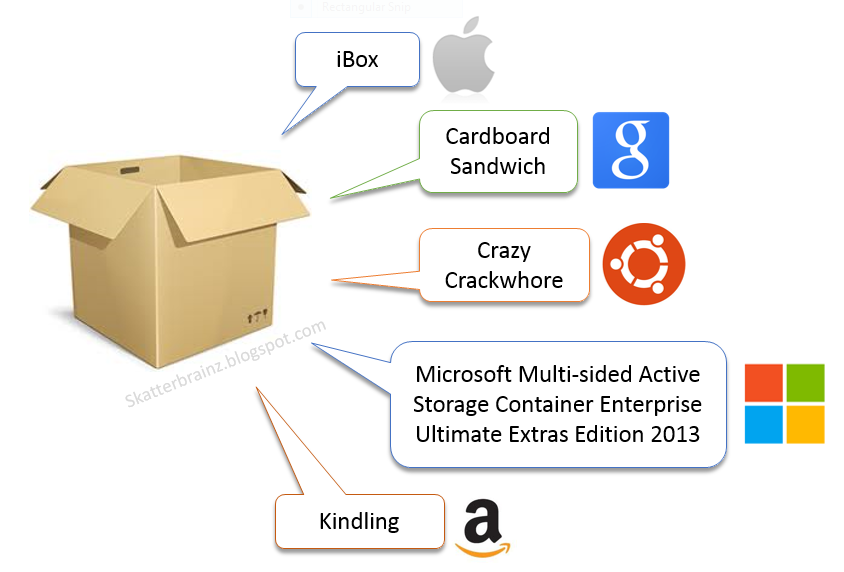
I dusted this off from the original I did in 2003. I updated the logos and added Amazon, but otherwise it's pretty relevant to today I think...
Wednesday, October 17, 2012
When is "Better" Really "Better"?
Years ago, like, way back in 2003, there was a thing that large software vendors used to do called an "open Beta" program. This was when the vendor would invite large numbers of current and potential customers to kick the tires on forthcoming new products, or new versions of existing products. Phew! That was a long-winded sentence, wasn't it?
Nearly every vendor, small to large, supported this approach to vetting their ideas for marketability. Some still exist. Some are long gone. Microsoft. IBM. Novell (who?). Allaire, later eaten by Macromedia, later to be gobbled up by Adobe. Autodesk. Sun Microsystems (now Oracle). Even WinZip had a "beta program" you could sign up for. The process was simple: You enrolled, downloaded the binaries, installed them and agreed to submit bug reports and feature requests. In the end, when the program concluded, you (most-often) received a complimentary license for the final product result. Many participants earned licenses for Windows, Office, AutoCAD, WinZip, ColdFusion, Dreamweaver, and many other products.
The best part of this whole era was the blurred distinction between the textbook definitions of "Alpha" and "Beta" as they pertain to software development.
You see, in the early days, when guys wore white button-down shirts with pocket protectors, and taped up glasses with slicked-over hair (yes, think IBM in the 1970's), the term "Alpha" meant that features were still in a state of flux, while "Beta" meant features were locked-down, but functionality and reliability needed to be tested. That's a big difference. Luckily for us (consumers/geeks), most of these vendors had spent so much time on the bong wagon that they forgot about such distinctions. It was fairly common to engage an engineer in a forum, or by e-mail, even by phone, to brainstorm about a new feature or idea. You could expect frequent build updates to reveal new features and options, even new UI changes, along the way.
Those days are gone. They have since been replaced with "Community Preview" and "Pre-Release" programs. These are died-in-the-wool "Beta" programs, where the ear for new ideas is Deaf, and all the vendor wants from you is a thumbs-up. If you have a thumbs-down, well, you're obviously not in their target demographic. When you encounter something you don't care for, you find yourself at a loss for avenues to submit your counter-suggestions back to the vendor. They really don't want to hear about it now. It's too late in the process. The bean-counters have put a stake in the ground for target release dates, and communicated it to their "platinum" partners and shareholders. To make drastic changes at that stage might risk their credibility with people who have NO idea what the "soft" in "software" really means. But they have the money and that's all that counts.
Take for example this situation:
You release an early "preview" version of the next version of your flagship product to the masses. The media outlets are given an even earlier "preview" so they can start the hype machine in full motion, thereby drumming up increased desire in the geek minds. The hype machine vortex is at stage two now. Stage one is when you start blabbering to the press about new features before letting anyone actually see them.
Within the first week, the Internet is a-buzz with some particular aspect of your new feature-set that users really don't care for. How bad do they not care for it? So bad that they start building add-on software to disable or modify that feature.
If that doesn't speak directly into the eyeballs and brains of those driving the machine (in this case: YOU), then you are already losing the battle.
Any half-decent first-year marketing student would say that if your customers are consistently and overwhelmingly changing your product in a very specific and consistent manner, then it's time you modify your product so they don't have to. It's called "customer satisfaction".
Ok. I've danced around this as thinly as I can without saying the obvious, so I'm just going to say the obvious:
Windows 8 "metro" tile interface might be nice for a touch-screen medium, but a mouse and keyboard (you know, the kind that almost ALL of Microsoft's customers still use) it sucks. That's not just my opinion, you can search Google or Bing or whatever you prefer and find plenty of gripes about the new interface on a traditional platform. And if anyone thinks the new UI is enough force du jour to entice even half of their install base to dump their desktops and buy Surface products to replace them, well, you need to put down the Kool Aid. But Microsoft says the new UI is "better". "Better" by who's rationale? Theirs? Obviously it's not the rationale of the thousands, maybe millions of users that have installed add-ons like ClassicShell or Start8, which suppress the tile interface and "restore" a Windows 7 style Start Menu.
I guess we're supposed to stop deciding for ourselves and accept what we're told? My ancestors would roll over in their graves at the thought of that.
Don't get me wrong, there's a lot to like about Windows 8. But just like Microsoft did with Windows 7, they missed the marketing train. Microsoft seems to insist on aiming their hype cannon at the general consumer, when their bread-and-butter base is really in enterprise environments and large organizations. Enterprises are more interested in things like automation, manageability, customization, configuration management, update management, security, reliability... and things that boil down to LOWER COST and INCREASED OUTPUT from their operations. But they hardly spewed a word about those things when promoting Windows 7, except within small circles (TechNet, MSDN, etc.).
I lost count of IT professionals who struggled to build their own business cases to convince their management to consider upgrading from XP to 7, when Vista left them totally cold. They shouldn't have had to do their own legwork. Microsoft should have sold it for them, but their big-dollar bullhorn was blasting out how "cool" it was/is, and the music and games, and trying to be cool and trendy with ads that mimic their contemporaries. I see the same thing happening with Windows 8, unfortunately.
My prediction is that an "option" will emerge to switch between them, at least on traditional platforms (desktops and laptops). Time will tell if Tiles are better than Start Menus and Desktops.
Nearly every vendor, small to large, supported this approach to vetting their ideas for marketability. Some still exist. Some are long gone. Microsoft. IBM. Novell (who?). Allaire, later eaten by Macromedia, later to be gobbled up by Adobe. Autodesk. Sun Microsystems (now Oracle). Even WinZip had a "beta program" you could sign up for. The process was simple: You enrolled, downloaded the binaries, installed them and agreed to submit bug reports and feature requests. In the end, when the program concluded, you (most-often) received a complimentary license for the final product result. Many participants earned licenses for Windows, Office, AutoCAD, WinZip, ColdFusion, Dreamweaver, and many other products.
The best part of this whole era was the blurred distinction between the textbook definitions of "Alpha" and "Beta" as they pertain to software development.
You see, in the early days, when guys wore white button-down shirts with pocket protectors, and taped up glasses with slicked-over hair (yes, think IBM in the 1970's), the term "Alpha" meant that features were still in a state of flux, while "Beta" meant features were locked-down, but functionality and reliability needed to be tested. That's a big difference. Luckily for us (consumers/geeks), most of these vendors had spent so much time on the bong wagon that they forgot about such distinctions. It was fairly common to engage an engineer in a forum, or by e-mail, even by phone, to brainstorm about a new feature or idea. You could expect frequent build updates to reveal new features and options, even new UI changes, along the way.
Those days are gone. They have since been replaced with "Community Preview" and "Pre-Release" programs. These are died-in-the-wool "Beta" programs, where the ear for new ideas is Deaf, and all the vendor wants from you is a thumbs-up. If you have a thumbs-down, well, you're obviously not in their target demographic. When you encounter something you don't care for, you find yourself at a loss for avenues to submit your counter-suggestions back to the vendor. They really don't want to hear about it now. It's too late in the process. The bean-counters have put a stake in the ground for target release dates, and communicated it to their "platinum" partners and shareholders. To make drastic changes at that stage might risk their credibility with people who have NO idea what the "soft" in "software" really means. But they have the money and that's all that counts.
Take for example this situation:
You release an early "preview" version of the next version of your flagship product to the masses. The media outlets are given an even earlier "preview" so they can start the hype machine in full motion, thereby drumming up increased desire in the geek minds. The hype machine vortex is at stage two now. Stage one is when you start blabbering to the press about new features before letting anyone actually see them.
Within the first week, the Internet is a-buzz with some particular aspect of your new feature-set that users really don't care for. How bad do they not care for it? So bad that they start building add-on software to disable or modify that feature.
If that doesn't speak directly into the eyeballs and brains of those driving the machine (in this case: YOU), then you are already losing the battle.
Any half-decent first-year marketing student would say that if your customers are consistently and overwhelmingly changing your product in a very specific and consistent manner, then it's time you modify your product so they don't have to. It's called "customer satisfaction".
Ok. I've danced around this as thinly as I can without saying the obvious, so I'm just going to say the obvious:
Windows 8 "metro" tile interface might be nice for a touch-screen medium, but a mouse and keyboard (you know, the kind that almost ALL of Microsoft's customers still use) it sucks. That's not just my opinion, you can search Google or Bing or whatever you prefer and find plenty of gripes about the new interface on a traditional platform. And if anyone thinks the new UI is enough force du jour to entice even half of their install base to dump their desktops and buy Surface products to replace them, well, you need to put down the Kool Aid. But Microsoft says the new UI is "better". "Better" by who's rationale? Theirs? Obviously it's not the rationale of the thousands, maybe millions of users that have installed add-ons like ClassicShell or Start8, which suppress the tile interface and "restore" a Windows 7 style Start Menu.
I guess we're supposed to stop deciding for ourselves and accept what we're told? My ancestors would roll over in their graves at the thought of that.
| (image copyright: Lifehacker.com) |
I lost count of IT professionals who struggled to build their own business cases to convince their management to consider upgrading from XP to 7, when Vista left them totally cold. They shouldn't have had to do their own legwork. Microsoft should have sold it for them, but their big-dollar bullhorn was blasting out how "cool" it was/is, and the music and games, and trying to be cool and trendy with ads that mimic their contemporaries. I see the same thing happening with Windows 8, unfortunately.
My prediction is that an "option" will emerge to switch between them, at least on traditional platforms (desktops and laptops). Time will tell if Tiles are better than Start Menus and Desktops.
Wednesday, March 14, 2012
State of the Tech Industry: Sort Of.
Here's my two-cent predictions: Keep in mind that I don't own stock or any vested interest in any tech company. My employer is a partner of Microsoft, VMware, Cisco, HP, NetApp, and others. We work on all major platforms, and my personal role is in the area of software deployment automation and business systems automation. We don't sell hardware or software. We sell services. Ok, enough of the disclaimer crap...
Regardless of the blabbering from all of the Android tablet vendors, Apple will remain comfortably in the lead of the tablet market for at least the next two years (out to 2014 at least). Android tablets won't even match it in terms of sales or market share (for similar form factors). iPad will remain on top of the market for a long time to come. This isn't just my view. It's also the view of most major tech industry analysts.
Microsoft will make major gains in server virtualization when Windows 8 Server Hyper-V ships, which will cause EMC/VMware to cut prices and shift their pawns on the board to avoid losing customers. Cost alone will be a huge weapon, especially when reviews start pouring in about Hyper-V's improved features, scalability, reliability and uptake.
Microsoft will make smaller, but noticeable, gains in market-share against Oracle with SQL Server 2012. The new features and capabilities, combined with the much cheaper cost, will be hard for cost-conscious customers to ignore. It will be slow gains at first though.
Flexera Software will continue to prosper from the looming death of Wise Package Studio and the ignorant stupidity of Symantec. There is now an effective monopoly in the software packaging and repackaging market, but it's under the RADAR of almost everyone, so they will slide through comfortably to a nice profit margin. More businesses are adopting FlexLM and FlexNet Manager products as well, so support revenues will continue to grow at modest rates.
Windows 8 uptake will be slow but respectable in the consumer market. In the business/enterprise market however, it will be negligible. Not because it's a bad product or anything like that. Here's why: Most businesses are JUST NOW ramping up to migrated to Windows 7, which has bumped up budgets for hardware replacements, additional memory, hard drives, and other bandaids. Most of them are in a position in 2012 where they're either far enough into Windows 7, that it makes no sense to shift into Windows 8 within the next year at the soonest. Add to that those that are still on XP who see what Windows 8 CP reviews are shaping up to be. It's being perceived as a pure consumer play. Tablets. Not for business desktops or laptops. Some will buy it, but nowhere near has significantly as Windows 7 has seen.
Now, Windows 8 Server will be a different ball game entirely. I see that making significant gains in late 2012 and early 2013. Mainly because (A) a lot of customers have stayed on Windows Server 2008 and waited out R2, and (B) the new features in Windows Server 8 will woo a lot of them to skip R2 entirely, which wouldn't be a bad move. There's nothing wrong with R2, but let's face it: There are few, if any, "gotta have" features in it for most businesses as it relates to the upgrade cost. Windows Server 8, on the other hand, packs a pretty big punch. The bang for the buck is on the side of Windows Server 8:
Regardless of the blabbering from all of the Android tablet vendors, Apple will remain comfortably in the lead of the tablet market for at least the next two years (out to 2014 at least). Android tablets won't even match it in terms of sales or market share (for similar form factors). iPad will remain on top of the market for a long time to come. This isn't just my view. It's also the view of most major tech industry analysts.
Microsoft will make major gains in server virtualization when Windows 8 Server Hyper-V ships, which will cause EMC/VMware to cut prices and shift their pawns on the board to avoid losing customers. Cost alone will be a huge weapon, especially when reviews start pouring in about Hyper-V's improved features, scalability, reliability and uptake.
Microsoft will make smaller, but noticeable, gains in market-share against Oracle with SQL Server 2012. The new features and capabilities, combined with the much cheaper cost, will be hard for cost-conscious customers to ignore. It will be slow gains at first though.
Flexera Software will continue to prosper from the looming death of Wise Package Studio and the ignorant stupidity of Symantec. There is now an effective monopoly in the software packaging and repackaging market, but it's under the RADAR of almost everyone, so they will slide through comfortably to a nice profit margin. More businesses are adopting FlexLM and FlexNet Manager products as well, so support revenues will continue to grow at modest rates.
Windows 8 uptake will be slow but respectable in the consumer market. In the business/enterprise market however, it will be negligible. Not because it's a bad product or anything like that. Here's why: Most businesses are JUST NOW ramping up to migrated to Windows 7, which has bumped up budgets for hardware replacements, additional memory, hard drives, and other bandaids. Most of them are in a position in 2012 where they're either far enough into Windows 7, that it makes no sense to shift into Windows 8 within the next year at the soonest. Add to that those that are still on XP who see what Windows 8 CP reviews are shaping up to be. It's being perceived as a pure consumer play. Tablets. Not for business desktops or laptops. Some will buy it, but nowhere near has significantly as Windows 7 has seen.
Now, Windows 8 Server will be a different ball game entirely. I see that making significant gains in late 2012 and early 2013. Mainly because (A) a lot of customers have stayed on Windows Server 2008 and waited out R2, and (B) the new features in Windows Server 8 will woo a lot of them to skip R2 entirely, which wouldn't be a bad move. There's nothing wrong with R2, but let's face it: There are few, if any, "gotta have" features in it for most businesses as it relates to the upgrade cost. Windows Server 8, on the other hand, packs a pretty big punch. The bang for the buck is on the side of Windows Server 8:
- Hyper-V 3.0 (with concurrent Live Migration, VHDX, etc.)
- Disk Data Dedupe
- AD integrated KMS activation
- DHCP redundancy
- Improved Clustering and Cluster Shared Volumes
- Claims Based Authentication
- SMB 2.2
- AD DC cloning
- Improved Branch Cache
- NIC Teaming
- Enhanced PowerShell 3.0 features (web interface, Intelli-Sense, etc.) In fact, the entire OS is written CMD shell first, and GUI afterwards. Sound familiar?
- A newer, leaner Core edition
- Trevor Pott does a good job of itemizing Windows Server 8. Check it out.
Bing will continue to lose money for Microsoft, but they'll play a shuffle game with other OSD projects and roll in Xbox, Ad services, and Metro and make it confusing to isolate which hole is sucking the most revenue.
Someone will buy RIM, kill off the product line (Blackberry) and rape the IP treasure chest. There's no future value in the products themselves anymore, but the patents are worth a ton. Wouldn't it be poetically ironic if NTP were to acquire RIM?
Symantec and McAfee will soon begin the long, slow, depressing march to their deaths. With Microsoft rolling ForeFront and Security Essentials evermore tightly into their products, at little or no cost to consumers, those one-trick ponies will be searching for new revenue streams, probably stepping into the Linux services market like Novell tried. Look how well that worked for them.
We'll either keep Obama or get a new president, but nothing will change for any of us regular working folks. It never does. It never will either. Just keep watching your favorite TV show or sports games, that will keep you distracted and happy.
We'll continue to hear about Iran in the news for a long time to come, but the U.S. will do nothing militarily against them directly. It will be another year of lip service.
Someone will find, capture or kill Kony. Another Kony-clone will pop up within 15 minutes to replace him.
Gas prices will continue to fluctuate, but gradually rise through the Summer. We will all bitch and moan like babies, but swipe our credit cards and fill up like good sheep. Congress will pretend to "haul" the oil company executives in front of "panels" on TV, to act like they're slapping them around, only to appeal to voters and win another term. Ultimately, nothing will happen to the oil companies and we will be happy to give them more of our money like good sheep do.
It's March 14, 2012. Check back on this March 14, 2013 and see how well I predicted this mess.
Wednesday, February 1, 2012
Firefox 10, Chrome 20 - I Remember When Versions Mattered
Call me old and out of date. Go ahead. I'll wait..... ... .. ..... .... I fell asleep, sorry. Where was I? Oh yeah, I was about to embark on yet another rant about the sad state of software development and business overlords. You're not going to believe me, but I haven't consumed any alcohol or caffeine prior to writing this lengthy torture of the senses. It's true. I'm actually about to fall asleep following a long day and a rigorous workout, which was long overdue.
Here it is in a nutshell...
In the 1990's, software products were made by developers. Those days are gone.
In 2012, software products are written by developers, chained to their cubicles by leather thong-wearing MBA "marketing" and "project" management freaks with gold-plated gas masks on. They are marched into conference room meetings to discuss project plans, schedules, resource allocations and who keeps fucking up the toilet in the men's restroom.
It's all about shareholder value now. I'll repeat that...
IT'S ALL ABOUT SHAREHOLDER VALUE NOW.
The misty-eyed days of developers passing the bong around, followed by the Dorito's, and the warm cans of Bud Lite, sharing ideas of revolutionary paradigm shifting, are gone. Splayed out like a Mexican drug execution scene, over an assorted mismatched array of bean bag chairs, and futons, orange crate coffee tables, with Led Zeppelin or Buckethead playing in the background. Discussing ideas for the next cool software project or feature update. Losing a bet over the lyrics to that last song and having to drink the bong water. GONE. Actually meeting with users (we didn't call them customers back then, that came later, after the suits invaded) to discuss what they like and don't like. Then actually, get this, you're going to call bullshit here: went back and incorporated the user's ideas into the software product. Amazing!
Gone.
Developer's today talk mostly about the following key points:
Here it is in a nutshell...
In the 1990's, software products were made by developers. Those days are gone.
In 2012, software products are written by developers, chained to their cubicles by leather thong-wearing MBA "marketing" and "project" management freaks with gold-plated gas masks on. They are marched into conference room meetings to discuss project plans, schedules, resource allocations and who keeps fucking up the toilet in the men's restroom.
It's all about shareholder value now. I'll repeat that...
IT'S ALL ABOUT SHAREHOLDER VALUE NOW.
The misty-eyed days of developers passing the bong around, followed by the Dorito's, and the warm cans of Bud Lite, sharing ideas of revolutionary paradigm shifting, are gone. Splayed out like a Mexican drug execution scene, over an assorted mismatched array of bean bag chairs, and futons, orange crate coffee tables, with Led Zeppelin or Buckethead playing in the background. Discussing ideas for the next cool software project or feature update. Losing a bet over the lyrics to that last song and having to drink the bong water. GONE. Actually meeting with users (we didn't call them customers back then, that came later, after the suits invaded) to discuss what they like and don't like. Then actually, get this, you're going to call bullshit here: went back and incorporated the user's ideas into the software product. Amazing!
Gone.
Developer's today talk mostly about the following key points:
- How to leverage "social media" and "social networks"
- How to infuse HTML5 or J-Query into their app
- How to build a brand and sell it to the first bidder
- How to get t-shirts printed for their weekly bungee jumping team meet-up
- Putting up a new web form to get customer feedback
- Building in telemetry to collect user statistical data
- Taking bets on the IPO share price, for, you know, whenever you IPO
Sure, there are some clever kids smacking the monkey keys, and a lot of them can do amazing things with the latest toolz. Notice that hep "z" ending there? Ha! I'm still a hep dude. Oh yeah. They can do truly amazing things. But unless they have a messiah leading them through the valley of the shadow of venture capital, they won't fear evil, but evil will own them soon enough. A messiah like Zuck, or Mason, or Williams, Brin or Paige, offers vision over stock shares. The longer they can hold those beasts at bay the more time they have to cultivate vision, ideas and build great things. But eventually, the boardmembers take over and that's that.
The problem is that developers alone can only do so much before they hit the point where they need to sell something in order to support their dreams. Eventually, they'll need money. Money requires indebtedness, which requires becoming someone's bitch on a leash. The leash holders want some ROI (that's RETURN ON INVESTMENT, for you kids that skipped business class to huff Redi-Whip cans behind the gym). The lenders get money from their investors, who in turn have only so much patience before they see a return on their dollars.
Your caffeine-pumped, sugar-infused, emotionally-charged verbal carpet-bombing about "totally radical" and "gnarly" new features and the latest ball-crushing, brain-exploding technological uber-wonderness is about as effective against the multi-syllabic brain of a standard issue, model B, type I, mark IV, suit-encased, managerial labor unit, as Charlie Brown's school teacher. All they hear is "wah wah wah wah J-Query, blah blah Dot Net, blah blah, XML something, blah blah AWESOME!". They're more likely to have remembered the exact count of how many times MC Coder wiped Rock Star dribble from his mouth than the names of any of that techno-babble.
This is not how it used to be, kids.
There was a time, way back before Facebook, even Google, existed, when software was conceived, built, tested and supported by (get this, you're so NOT going to believe this...): developers!
No. I'm not kidding. For realz! (see that "z" again? ha ha!) Don't believe me? Check out the historical photos below. On the left you see imagination at work. Actually, they didn't think of it as work, even though they busted ass for insane hours with few breaks. On the right you see the seats, to be filled with whoever occupies the board's latest organization chart for discussing the budgets, cash flow, valuations, ROI, SWOT reports, and most likely: a never-ending "renewed focus" on cost reductions.
They were good times indeed. At least, what I can remember of them. It's a bit cloudy, you see.
But as for the early on reference to "Firefox 10", that was a sidebar thought actually. The reason behind that was that in those bong-slinging dayz (did you catch it this time? good. you're coming along nicely!) they actually used a fairly consistent rationale for applying version numbering. Granted, there were variations and deviations, but compared to today, it was 100x more consistent, even across UNIX forks, Windows 3.x and NT, and Mac OS. A "major" version meant a radical, significant, kicked square in the crotch with ice-climbing boots on, change. Earth shattering. Paradigm shifting (back when that meant something as well). An "Oh shit!" moment for most customers (smiling as they said it).
A "point release" or "minor release" was for tweaks, upgrades, adjustments, etc. Or as to put it in terms of one of my professors...
Major = Revolutionary
Minor = Evolutionary
I'm sorry, but Firefox 5, 6, 7, 8, 9, 10 are really minor releases. They didn't completely overhaul the entire product with each of these, so why did they do this? Marketing. Pure and simple marketing. When market share is stagnating or falling, you have to pump up interest, and that demands turning on the Hype machine. The Hype machine as a huge funnel on the top that you feed copious amounts of bullshit into and it grinds it into marketing material. Brochures, Memos, Pamphlets, Web Sites, DVD's, fold-up kiosks, TV ads, and tons and tons and tons of meme terminology to verbally inject into the brains of anyone withing talking distance.
I have to tip my hat to Google for at least not only playing the version numbers down, but almost ignoring them entirely. You don't ever see a blurb about the "new version 16!" for Chrome. Never. You have to dig for it yourself. Sometimes (especially if you're on the dev channel like I am) you aren't even sure what version you're using until you stop and check.
The Future
The future is always the same. I forget who said that, but it was someone famous, I'm pretty sure. Facebook is about to do their IPO. They will slowly succumb to the boiling frog syndrome, whether they like it or not. The heat will start out low, and gradually increase, over months or a year, but not too much more than three years, you won't recognize Facebook as it is known today. It will become another corporate cube farm with the expected food court, exercise facility, and Zuck will gain 40 lbs and start balding. Trust me, I've seen it before. As it starts to stagnate, users will be watching for the "next big thing" and flee like rats as soon as something shiny and blinking comes along. That may take a few years, but it will happen.
And that, kids, is why the future of software development is going to suck.
Cheers!
Tuesday, December 20, 2011
If You Watch One Video on this Site...
You need to watch this one. Gary Vaynerchuk has been around for a long time, even before Wine Library TV, he was a mover and a shaker. A brilliant guy. Pardon the language (NSFW), but the message makes the f-bombs forgettable. Enjoy!
Sunday, December 4, 2011
How AutoCAD Changed the World
That's kind of a bold, hype-ish title, am I right? You're probably rolling your eyes, or saying "yeah, sure, whatever" or something like that. But give me a chance to explain...
Back in the early 1980's, if you did any "design" or "drafting" work, you were most likely working on a physical drawing board and tracing your ideas out on Vellum, Paper, or Mylar sheets using various kinds of mechanical pencil materials or maybe a Rapidograph ink applicator. Maybe you used templates and lettering guides, or shape tracers or flexible curves and those stupid-looking weights we called "ducks" or "whales". In the mid-1980's came the first real significant influx of computerized design technologies. They had weird names like AutoTrol, CADAM and so on. They were collectively termed "CAD" for Computer Aided Design. If they were connected to manufacturing machinery, they were called "CAD/CAM" for CAD + "Computer Aided Manufacturing" (or "Machining"). If they did engineer calculations from design data, they were called "CAD/CAE" some were "CAD/CAM/CAE" and some were just stupid and we called them "overpriced crap". But they were magical for their time.
Here's the snapshot of "before": These first-generation CAD/CAM/CAE systems only, I repeat ONLY, ran on UNIX platforms. Not only that, but most were tuned for specific UNIX platforms, so they were hardware specific, such as DEC, IBM, Sun or a few others (most of which are all gone now). The software alone was often in the $10,000 to $30,000 range PER SEAT. The hardware was just as expensive, or even more expensive. I worked on one system back in that era that was priced at $50,000 for the hardware "workstation" and the design software. Keep in mind that you HAD to purchase vendor support since they did not allow you to work on it yourself, often keeping many of the features, settings and capabilities secret until you paid someone to reveal them to you. Oh yeah. Good times they were not.
Then came along some scrappy little company named Autodesk and they had this cheap little CAD product called "AutoCAD" that actually ran on an IBM-PC. The other vendors laughed and tried to ignore it. I remember an IBM rep saying to us "that's a toy - a piece of crap that'll never go anywhere". I sure wish I could have recorded that for later on.
Maybe you've heard the story of the butterfly that caused a hurricane. This is very similar.
So, as this tiny little snowflake rolled through the fledgling IBM-PC "compatable" market, it began to gather some snow and grow bigger and heavier. For the peanut gallery out there: I'm not implying it was bloated. It wasn't. It became heavier with customers and customer momentum. Still a bit immature at R9, it made heads turn at R10 and R11. Then R12 came out and that snowball was now the size of a truck and rolling faster. As the UNIX market began to respond, it lost some of its footing as well. The big players started losing key developers and managers to smaller startups, all trying desperately to stir up excitement to fend off this new upstart called the "PC". Computervision stumbled, which led to Intergraph and Pro/Engineer. CADAM, Unigraphics and others started making adjustments, and even tried "realigning" licensing costs, but they caught some breathing room when Autodesk stumbled with R13. Then came R14 and it was pretty much a done deal as far as customers balling up those checks for the expensive UNIX fees, and stroking new checks to the much less expensive PC product lines.
As customers moved from UNIX to Windows and Windows NT at an increasing rate, so too did many stalwart UNIX product vendors. CAD/CAM/CAE products previously only available on UNIX were suddenly announcing PC versions. Even the most discerning NASTRAN vendors were poking at the PC market, especially as the PC hardware specs began an accelerated upgrade path.
I saw this firsthand at least four employers, and dozens of businesses I interacted with, and multiple branches of the U.S. Department of Defense: Navy, Army, Air Force, USMC, Coast Guard, even NASA.
No other PC-based CAD product had as much impact on the CAD market, and pushing customers to take the PC platform seriously. It also pointed the light on their budgets and ROI, and suddenly program managers were faced with making serious choices about continuing on with their life-draining budget expenditures, or doing some soul searching about this new PC-based direction.
The rest is history.
Is the UNIX market dead? No. Not at all. Has it scale back? Yes. Most of the major UNIX vendors from Compaq, Sun, Prime, DEC, Silicon Graphics, Helix, Unigraphics, are gone, or have been acquired and renamed. IBM, Dassault, and Integraph remain vibrant, while PTC has undergone multiple shifts in product and services offerings, but seems to be alive and well. One major change from twenty years ago has been the emergence of Siemens.
But even with these legacy companies still bouncing along, they've ported most, sometimes all, of their products to the Windows platform. Love them or hate them, that little snowflake had an impressive impact indeed.
Back in the early 1980's, if you did any "design" or "drafting" work, you were most likely working on a physical drawing board and tracing your ideas out on Vellum, Paper, or Mylar sheets using various kinds of mechanical pencil materials or maybe a Rapidograph ink applicator. Maybe you used templates and lettering guides, or shape tracers or flexible curves and those stupid-looking weights we called "ducks" or "whales". In the mid-1980's came the first real significant influx of computerized design technologies. They had weird names like AutoTrol, CADAM and so on. They were collectively termed "CAD" for Computer Aided Design. If they were connected to manufacturing machinery, they were called "CAD/CAM" for CAD + "Computer Aided Manufacturing" (or "Machining"). If they did engineer calculations from design data, they were called "CAD/CAE" some were "CAD/CAM/CAE" and some were just stupid and we called them "overpriced crap". But they were magical for their time.
Here's the snapshot of "before": These first-generation CAD/CAM/CAE systems only, I repeat ONLY, ran on UNIX platforms. Not only that, but most were tuned for specific UNIX platforms, so they were hardware specific, such as DEC, IBM, Sun or a few others (most of which are all gone now). The software alone was often in the $10,000 to $30,000 range PER SEAT. The hardware was just as expensive, or even more expensive. I worked on one system back in that era that was priced at $50,000 for the hardware "workstation" and the design software. Keep in mind that you HAD to purchase vendor support since they did not allow you to work on it yourself, often keeping many of the features, settings and capabilities secret until you paid someone to reveal them to you. Oh yeah. Good times they were not.
Then came along some scrappy little company named Autodesk and they had this cheap little CAD product called "AutoCAD" that actually ran on an IBM-PC. The other vendors laughed and tried to ignore it. I remember an IBM rep saying to us "that's a toy - a piece of crap that'll never go anywhere". I sure wish I could have recorded that for later on.
Maybe you've heard the story of the butterfly that caused a hurricane. This is very similar.
So, as this tiny little snowflake rolled through the fledgling IBM-PC "compatable" market, it began to gather some snow and grow bigger and heavier. For the peanut gallery out there: I'm not implying it was bloated. It wasn't. It became heavier with customers and customer momentum. Still a bit immature at R9, it made heads turn at R10 and R11. Then R12 came out and that snowball was now the size of a truck and rolling faster. As the UNIX market began to respond, it lost some of its footing as well. The big players started losing key developers and managers to smaller startups, all trying desperately to stir up excitement to fend off this new upstart called the "PC". Computervision stumbled, which led to Intergraph and Pro/Engineer. CADAM, Unigraphics and others started making adjustments, and even tried "realigning" licensing costs, but they caught some breathing room when Autodesk stumbled with R13. Then came R14 and it was pretty much a done deal as far as customers balling up those checks for the expensive UNIX fees, and stroking new checks to the much less expensive PC product lines.
As customers moved from UNIX to Windows and Windows NT at an increasing rate, so too did many stalwart UNIX product vendors. CAD/CAM/CAE products previously only available on UNIX were suddenly announcing PC versions. Even the most discerning NASTRAN vendors were poking at the PC market, especially as the PC hardware specs began an accelerated upgrade path.
I saw this firsthand at least four employers, and dozens of businesses I interacted with, and multiple branches of the U.S. Department of Defense: Navy, Army, Air Force, USMC, Coast Guard, even NASA.
No other PC-based CAD product had as much impact on the CAD market, and pushing customers to take the PC platform seriously. It also pointed the light on their budgets and ROI, and suddenly program managers were faced with making serious choices about continuing on with their life-draining budget expenditures, or doing some soul searching about this new PC-based direction.
The rest is history.
Is the UNIX market dead? No. Not at all. Has it scale back? Yes. Most of the major UNIX vendors from Compaq, Sun, Prime, DEC, Silicon Graphics, Helix, Unigraphics, are gone, or have been acquired and renamed. IBM, Dassault, and Integraph remain vibrant, while PTC has undergone multiple shifts in product and services offerings, but seems to be alive and well. One major change from twenty years ago has been the emergence of Siemens.
But even with these legacy companies still bouncing along, they've ported most, sometimes all, of their products to the Windows platform. Love them or hate them, that little snowflake had an impressive impact indeed.
Subscribe to:
Posts (Atom)