Showing posts with label apple. Show all posts

Monday, November 19, 2012

Why "Coming Soon" Can Be a Bad Idea

I'm not sure what drives some companies to want to show their hand early, while others play them close to the vest. Especially in the field of computer hardware and software.

I've read dozens of articles comparing the marketing philosophies of companies like Apple, Microsoft, Sony, Nintendo and Samsung. But the one in this list in a unique situation is Microsoft. They earn a major portion of their revenue from enterprise business sales and subscriptions. Enterprise customers, unlike consumers, live on quarterly and annual budget cycles.

When Sony or Nintendo announces a major product is "coming soon" in the consumer market space, it doesn't have the same effect on their market as what happens when Microsoft announces a new version of Windows is coming in six months.  Enterprise customers hear that and do the following:  Hold off on buying and upgrading.  Even if the pricing is tweaked to offer a "free jump" to the new version when buying the current version within X months of the release, that's not the real challenge.  The real challenge is dealing with another round of planning, preparation, testing, and deploying.  Then there's the user learning curve issue and training.  Even when many organizations opt out of training budget, they have to contend with the communications and hand-holding aspects.  Intranet posts, e-mails, meetings, meetings and more meetings.  It all adds up to pain.

Sure, it's not always practical to suddenly announce a major new release of Windows or Office, when enterprise customers, partners, OEMs, and developers need lead-time to get familiar with the new versions.  But there needs to be a better/happier medium than announcing a new release coming "next year".  Practical or not, my gut feeling is somewhere between three (3) and four (4) months is about right.  Thoughts?

Sunday, November 11, 2012

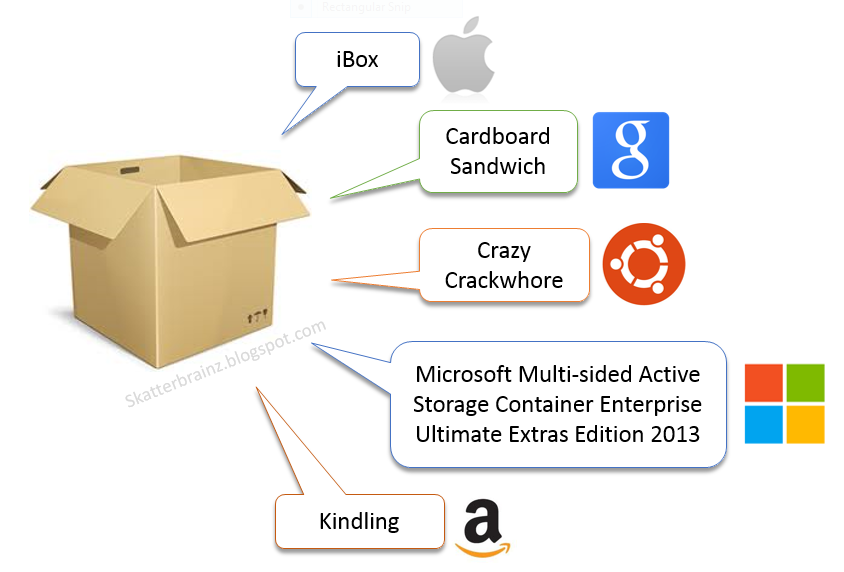
A Little Humor for Monday morning

I dusted this off from the original I did in 2003.  I updated the logos and added Amazon, but otherwise it's pretty relevant to today I think...

Wednesday, February 1, 2012

Firefox 10, Chrome 20 - I Remember When Versions Mattered

Call me old and out of date. Go ahead.  I'll wait..... ... .. ..... .... I fell asleep, sorry.  Where was I? Oh yeah, I was about to embark on yet another rant about the sad state of software development and business overlords.  You're not going to believe me, but I haven't consumed any alcohol or caffeine prior to writing this lengthy torture of the senses.  It's true.  I'm actually about to fall asleep following a long day and a rigorous workout, which was long overdue.

Here it is in a nutshell...

In the 1990's, software products were made by developers.  Those days are gone.

In 2012, software products are written by developers, chained to their cubicles by leather thong-wearing MBA "marketing" and "project" management freaks with gold-plated gas masks on.  They are marched into conference room meetings to discuss project plans, schedules, resource allocations and who keeps fucking up the toilet in the men's restroom.

It's all about shareholder value now.  I'll repeat that...

IT'S ALL ABOUT SHAREHOLDER VALUE NOW.


The misty-eyed days of developers passing the bong around, followed by the Dorito's, and the warm cans of Bud Lite, sharing ideas of revolutionary paradigm shifting, are gone.  Splayed out like a Mexican drug execution scene, over an assorted mismatched array of bean bag chairs, and futons, orange crate coffee tables, with Led Zeppelin or Buckethead playing in the background.  Discussing ideas for the next cool software project or feature update.  Losing a bet over the lyrics to that last song and having to drink the bong water.  GONE.  Actually meeting with users (we didn't call them customers back then, that came later, after the suits invaded) to discuss what they like and don't like.  Then actually, get this, you're going to call bullshit here:  went back and incorporated the user's ideas into the software product.  Amazing!

Gone.

Developer's today talk mostly about the following key points:

  • How to leverage "social media" and "social networks"
  • How to infuse HTML5 or J-Query into their app
  • How to build a brand and sell it to the first bidder
  • How to get t-shirts printed for their weekly bungee jumping team meet-up
  • Putting up a new web form to get customer feedback
  • Building in telemetry to collect user statistical data
  • Taking bets on the IPO share price, for, you know, whenever you IPO
Sure, there are some clever kids smacking the monkey keys, and a lot of them can do amazing things with the latest toolz.  Notice that hep "z" ending there?  Ha!  I'm still a hep dude.  Oh yeah.  They can do truly amazing things.  But unless they have a messiah leading them through the valley of the shadow of venture capital, they won't fear evil, but evil will own them soon enough.  A messiah like Zuck, or Mason, or Williams, Brin or Paige, offers vision over stock shares.  The longer they can hold those beasts at bay the more time they have to cultivate vision, ideas and build great things.  But eventually, the boardmembers take over and that's that.

The problem is that developers alone can only do so much before they hit the point where they need to sell something in order to support their dreams.  Eventually, they'll need money. Money requires indebtedness, which requires becoming someone's bitch on a leash.  The leash holders want some ROI (that's RETURN ON INVESTMENT, for you kids that skipped business class to huff Redi-Whip cans behind the gym).  The lenders get money from their investors, who in turn have only so much patience before they see a return on their dollars.

Your caffeine-pumped, sugar-infused, emotionally-charged verbal carpet-bombing about "totally radical" and "gnarly" new features and the latest ball-crushing, brain-exploding technological uber-wonderness is about as effective against the multi-syllabic brain of a standard issue, model B, type I, mark IV, suit-encased, managerial labor unit, as Charlie Brown's school teacher.  All they hear is "wah wah wah wah J-Query, blah blah Dot Net, blah blah, XML something, blah blah AWESOME!".  They're more likely to have remembered the exact count of how many times MC Coder wiped Rock Star dribble from his mouth than the names of any of that techno-babble.

This is not how it used to be, kids.

There was a time, way back before Facebook, even Google, existed, when software was conceived, built, tested and supported by (get this, you're so NOT going to believe this...):  developers!

No. I'm not kidding.  For realz!  (see that "z" again?  ha ha!)  Don't believe me?  Check out the historical photos below.  On the left you see imagination at work.  Actually, they didn't think of it as work, even though they busted ass for insane hours with few breaks.  On the right you see the seats, to be filled with whoever occupies the board's latest organization chart for discussing the budgets, cash flow, valuations, ROI, SWOT reports, and most likely: a never-ending "renewed focus" on cost reductions.


They were good times indeed.  At least, what I can remember of them.  It's a bit cloudy, you see.

But as for the early on reference to "Firefox 10", that was a sidebar thought actually.  The reason behind that was that in those bong-slinging dayz (did you catch it this time?  good.  you're coming along nicely!) they actually used a fairly consistent rationale for applying version numbering.  Granted, there were variations and deviations, but compared to today, it was 100x more consistent, even across UNIX forks, Windows 3.x and NT, and Mac OS.  A "major" version meant a radical, significant, kicked square in the crotch with ice-climbing boots on, change.  Earth shattering.  Paradigm shifting (back when that meant something as well).  An "Oh shit!" moment for most customers (smiling as they said it).

A "point release" or "minor release" was for tweaks, upgrades, adjustments, etc.  Or as to put it in terms of one of my professors...

Major = Revolutionary
Minor = Evolutionary

I'm sorry, but Firefox 5, 6, 7, 8, 9, 10 are really minor releases.  They didn't completely overhaul the entire product with each of these, so why did they do this?  Marketing.  Pure and simple marketing.  When market share is stagnating or falling, you have to pump up interest, and that demands turning on the Hype machine.  The Hype machine as a huge funnel on the top that you feed copious amounts of bullshit into and it grinds it into marketing material.  Brochures, Memos, Pamphlets, Web Sites, DVD's, fold-up kiosks, TV ads, and tons and tons and tons of meme terminology to verbally inject into the brains of anyone withing talking distance.

I have to tip my hat to Google for at least not only playing the version numbers down, but almost ignoring them entirely.  You don't ever see a blurb about the "new version 16!" for Chrome.  Never.  You have to dig for it yourself.  Sometimes (especially if you're on the dev channel like I am) you aren't even sure what version you're using until you stop and check.

The Future

The future is always the same.  I forget who said that, but it was someone famous, I'm pretty sure.  Facebook is about to do their IPO.  They will slowly succumb to the boiling frog syndrome, whether they like it or not.  The heat will start out low, and gradually increase, over months or a year, but not too much more than three years, you won't recognize Facebook as it is known today.  It will become another corporate cube farm with the expected food court, exercise facility, and Zuck will gain 40 lbs and start balding. Trust me, I've seen it before.  As it starts to stagnate, users will be watching for the "next big thing" and flee like rats as soon as something shiny and blinking comes along.  That may take a few years, but it will happen.

And that, kids, is why the future of software development is going to suck.

Cheers!
Sunday, August 14, 2011

Bullshit Monopolies

Thinking back from the 1990's to now...

Who FORCED anyone to buy Windows over other operating systems?  Did we not have access to buying OS/2, Mac, UNIX (one of a hundred flavors) or Linux?

Who FORCED anyone to buy Office?  Did we not have WordPerfect and later: OpenOffice?  Star Office?

Who FORCED anyone to use IE?  Did we not have Netscape, AOL, Firefox, Opera, Chrome and Safari?

Who FORCED anyone to use Google?  Did we not have Alta Vista, Excite, Lycos, Ask Jeeves, BigFoot, Web Crawler, Yahoo!, AOL and Bing?

Where the hell do these lawyers fish up people to file major law suits claiming they had no choices?  I don't get it.  I see Microsoft is building a consortium to file suit against Google search as being an unfair monopoly.  Wow.  So, apparently they've thrown in the towel on Bing having what it takes to draw customers away from Google.  I especially love it when my "free market" colleagues argue in favor of this practice, effectively admitting that a "free market" can't decide on its own and therefore requires government/legal intervention to correct bad behavior.  My how times have changed.

Thursday, July 29, 2010

Another Reason I HATE iTunes

So I map a drive letter to my server "music" share and add the songs to my iTunes library.  Then I replace my server and remap the drives to the same share names.  iTunes doesn't like it.  It ignores M:\ and somehow stores the UNC path behind the mapping.  It's too God-Damned stupid to figure out the song is in the same place on the same drive letter as it was before.  Windows Media Player can figure that out. Hell, even WinAmp could do that 10 years ago!  Apple doesn't hire the brightest people, just the ones who dress the part.

Tuesday, June 8, 2010

I'm So Tired of Half-Assed Work Passing as "Good"

Whether it's Facebook's constant gyrations that keep leaving bugs and quirks in every nook and cranny, or the CSS model, or Apple's iTunes and iPod devices, or Ford and GM automobiles, I'm just sick to death of everyone giving them a passing grade when there's so much bullshit.  We've become so accustomed to the bullshit level that we think it's normal now.  Cheap, thin, plastic dashboards with flimsy fixtures and awkward anti-ergonomic controls and indicators.  Inconsistent API models.  Devices that have predictable problems.  All of this shit we're just getting used to as being "OK".

It's NOT OK.

Folks: Hold these dipshit’s feet to the fire and DEMAND better results.  Our grandparents sure did.  They didn't buy cheap shit.  They wouldn’t stand for it.  That's why their stuff lasted.  You think anything you purchased in the past 5 years will last long enough to pass down to your kids or their kids?!  Hell no!  Maybe SOME furniture could qualify.  But none of the electronic junk we have now will last that long, and it's not even supposed to.  We know that.  Everyone knows that cellphones have a limited lifespan.  Cars have a limited lifespan.

Look, my grandfather drove his old Ford Galaxy to over 250,000 miles by just "taking care of it" rigorously.  He NEVER overhauled the engine or transmission.  It was built to last.  Same goes for one of my old neighbors and his 1953 Oldsmobile.  Some of those cars ended up in backyards with weeds growing around them, but they didn't rust out to nothing.

Yes, there have been some improvements like air bags, GPS, crumple zones, collapsable steering columns, radial tires, and so on.  But the overall product doesn't last as long.  It's disposable.  We're a disposable culture.  Everything is throw-away and we’re just fine with that.  But the unintended side-effect is that we’re also just fine with shoddy quality.  No, wait a minute, let me qualify that quantification gyration a bit:

It’s not that things are just shoddy.  They’re designed to be sufficient for a specific lifetime.  After that they fall apart.  You have to baby the hell out of most products to keep them in top shape even up to their expected point of death.  Beyond that and you have to adopt a whole new religious practice to keep it looking and working good.  Engineering is getting that granular folks.  Engineered lifespan is a valuable commodity in today’s industrialized markets.  This is especially true if the lifespan plays into a revenue model that ties in with some sort of overarching service (think cell phone features, iPod, digital cameras).

But getting back to my original thought, which is that in some respects there is shoddiness throughout the products and we’re just blind to it from overexposure.

Cases in point:

Facebook – The Notes feature is quirky as hell.  Create a “Draft” and save it, but don’t publish it.  Then leave it and try to get back to it.  You can’t.  Not unless you start another Note and cancel it, and THEN you get a link to “Drafts”.  How many ways can you get to parts of your personal profile?  Shouldn’t one be enough?

Twitter – I think it should just make the stupid whale image with the “oops, sorry, our shitty-ass crap-app is overloaded again – try later” as the default home page.  Everytime some lame-ass code-nerd tries to snob me with some bullshit pitch about Ruby being superior, I just point to Twitter and scream like Sam Kinison.

iPod Nano – PIECE OF SHIT.  Period.  I somehow ended up with five (5) of these f-ing pieces of trash.  All from different sources (two direct from Apple.com), and at different times.  They lock up constantly. The “shuffle” is as predictable as a political speech.  Apple gets a free handjob pass from the fanboy crowd because it’s hep to have anything with a Cupertino fruit symbol on it.

Live Messenger – Oh my God.  Forget the chat aspect, IF you can find the chat space behind all the cluttery over-bloated buttons and ads.  Move that shit out of the way and let me chat gd-it!

Apple Update – NO – I DO NOT WANT SAFARI ON MY WINDOWS DESKTOP!!!!!!  Stop shoving it in my face!!!

Symantec – Just please, put down the crack pipe and stop bloating out your code to death.  Soon it will require a Cray SMP with 40 terabytes of memory just to load your “Security” product suite.  The only way it makes a computer secure is by rendering it unresponsive, so even bad code can’t get a slice of that CPU.

Autodesk – Please, I beg you, listen to me for one second: there are many of us (you know, those people called “customers”) that (a) do not want to wait for WsCommCntrl.exe to stop hogging the CPU in order to get working in AutoCAD and get the boss off our backs, and (b) don’t have time or company policy allowance to participate in your Customer Improvement Program.  Let us TURN THAT SHIT OFF PERMANENTLY!  Stop burying it in places intended only to make it difficult to disable it.  It aggravates the shit out of us and it’s really tiresome.  If you want to know what we think, pick up the phone and call us.

Adobe – Really?  Seriously?!  Are you kidding?!  You charge HOW MUCH for Acrobat Professional?  Holy f-ing cow!  To make fancy PDF files.  I suppose you’re ok with charging $100 per square of toilet paper in your company restrooms too?  And why is PhotoShop so expensive?  Do you read?  People are actively looking for cheaper alternatives and they’re actually finding them.  I’d be worried if I were you.  Get real.  Drop your ridiculous pricing.

Google – Can you please put a consistent interface on your vast array of web products?  I mean, seriously.  How many engineers do you employ?  How much do you spend on the infamous cafeterias and daycares? Can you spare a few bucks to clean it up a bit?  Maybe get things out of “beta” in less than 5 years.

Microsoft – R2?  What’s that?  Windows 7, Windows Server 2008, IE9, Expression 4.  Hey, how about forming a committee to tackle the problem with version numbering?  Which is it: a number or a year?  And does every product really need 11 syllables?  System Center Operations Manager?  System Center Virtual Machine Manager?  Can we dispense with the “System Center” prefix?  And while you’re at it, how about cleaning up the mess your developers have made with things like MSXML service packs, and .NET updates?  IT folks are struggling to package and push that stuff to thousands of computers.  You could help us out a little.

Mobile Apps – Don’t tell me how “mobile” is going to overtake the desktop when your stinky mobile apps still don’t have all the features or options I have with the crusty old web desktop version. Facebook and Twitter for mobile devices still cuts your hands off when you need to do certain things.  Shouldn’t a mobile app be AT LEAST equal to it’s web counterpart?

And, speaking of AT LEAST: what happened to the idea that an “upgrade” should never take a step backwards?  Why do so many upgrades seem to quietly remove something we had in the previous version?

Let’s go back to making QUALITY code, ok?

Thursday, February 4, 2010

Is Microsoft Imploding?

My brothers sent me (separately) links to the recent NYT article by Dick Brass on the demise of Microsoft at their own hand.  It’s titled “Microsoft’s Creative Destruction”.  My first reply was kind of errantly focused on the broader issues of Apple and Google and whether Microsoft really figures into that triad of triviality.  Whatever that means.

My second reply came after a few more re-readings…

“Ok, after a second, and indeed a third reading of this article, I wanted to address it from his same point of view:

He's correct.

From what I gather from talking with the few I know who work there, or used to work there, there are bright spots within the company: The System Center division is producing remarkable products and gaining not only accolades but marketshare.  Office 2010 is already garnering praise in ways similar to Windows 7.
One of the blogs I follow daily is that of "Mini-Microsoft".  An (supposedly) unidentified "insider" who has become widely recognized as the internal voice of "what's wrong" within the inerds.  Even MS execs cite his posts often (there's even a Channel 9 video interview with Lisa Brummel, Microsoft's VP of Human Resources which focuses almost entirely on Mini's complaints and suggestions).
The company is fucking huge. Too huge.  It's like GM.  World-wide, multi-cultural and multi-language.  I have no idea how anyone could effectively manage a project which is literally parsed out around the globe like Windows and Office are.  It reminds me of the overwhelming complexity of designing and building an aircraft carrier.  It's just magic I suppose.  I may never understand how it works.
I agree with his overall take and that it's a big question mark.  Most would agree that one of their biggest faults is that they're easily distracted by irrelevant markets and deluded into believing they become threatening “competition”.  Markets like mobile media players, game consoles, web browsers, search services, and mobile operating systems.  They chase the wrong vermin.  It wastes their time, energy and budgets and makes them look oafish in the end.
As a comparison however, Apple has had their share of problems and problem decisions.  They are executing fairly well overall, but lately they too seem to be wavering a bit.  Ironically, the iPad is a good example mainly because there was almost nothing announced that wasn't anticipated.  That's a subtle but significant "first" for Apple in over a decade.  The iPad should've blown people away.  Instead it was just "pretty cool".  I don't know anyone, Apple enthusiast or not, who is saying "I have GOT to get one of those!"  Not like they did with the iPod Touch or the iPhone.  Even Macbook's got more excitement buzzing from their launch than this.  And like I said before: the design is shockingly un-exciting for an Apple "first".  It's just, well, Microsoft-ish.
A lot of buzz is coming out of Google that they too are facing a point of inflection.  They've grown in size to rival early Microsoft.  Shear number of employees, global dispersion (time zones, languages, cultures), and now they're starting to feel the gradual tug of market gravity as they fall into a (for now) tiff with Apple in both the phone and tablet markets.  Did you notice that within 24 hours of Jobs making his recent "Google is evil" comment that Google unlocked the multi-touch feature on the Nexus phone?  It was sure talked about in the tech community.  They've already been showing off their Chrome OS tablet with multi-touch as well.  Schmidt and Jobs are shaping up to be quite a pair.  All they need is TMZ following them around and it will be great ratings fodder.
But, the issue there is that Google is starting to chase side markets.  Remember, they get almost 99 percent of their revenue from advertising.  Everything else is given out "free" or laced with ads.  It's a smart approach, but only while the game rules are like they are now.  Things will change of course.
And what will happen to Apple when Jobs departs (or passes on)?  There really isn't anyone else with the same charisma, command and confidence to instill a sense of a bold future beyond that.  Schiller? Oppenheimer?  Cook?  Serlet?  Tammadon?  I don't think so.
It seems to be shaping up like Gates handing the baton to Ballmer.  What a mess.
So, back to the path:  Yes, Microsoft has dealt themselves some pretty horrific blows over the years.  He didn't even touch on the NetDocs vs Office battle that raged for years.  That was infamous.  They're still blowing their own heads off in the Windows Mobile space (WM 7 has been promised and delayed for years.  Still not certain).  They shot from the hip with Windows Home Server, which is an amazing product, released with almost no meaningful official "push", more of a small-team grass-roots effort.  But the only partners they could rustle up were Toshiba and HP and only HP is making any profit.  They're still scoffing at Netbooks and gave up on Tablets (like he mentioned).  And they've taken way too long to counter Google Docs.  However, Google has remained silent on a counter to Microsoft's SkyDrive, which blows my f**king mind to Jupiter how they could have missed that obvious opportunity.  Microsoft actually has multiple, including Live Mesh.  Another example of a multi-headed beast marching in twenty directions at once.
I could go on and on, but for every goof they've made, they've somehow managed to crank out an equal success,even if small.  I think that's how they've managed to hold on.  That and the fact that they've won over IT geeks for years with their focus and attention on the plumbing technologies like COM, WMI, SNMP, LDAP, .NET, RPC, WinRM, WPF and so on.  They are the absolute king of API's and documentation. They know how to make building blocks that stick together like Lego's.  That is like heroin for enterprise IT admins and corporate developers. Actually, more like crack.  IBM ignored that too long and lost the game.  Apple ignores it.  Google sees that but is only building the kits for use outside the corporate space, which is a gamble.  Time will tell.
Footnotes:
XBox comment – Yes, it’s a worthy component of their consumer base.  But it’s widely believed to be a break-even prospect for them internally.  Even their relationship with Bungee has been someone unclear at times.
WHS comment – The storage problem early on highlighted a disparity between the WHS group and other groups dealing with storage.  The lack of partner product momentum at the outset was an indication of initial uncertainty, when it should have been more prominent and visible.
Plumbing technologies comment – Yes, I know they didn’t invent many of those mentioned, but they did exert incredible effort in tying them into their products across multiple divisions no less.  And the efforts of TechNet and MSDN are no less than amazing in their own rite.
Google – I didn’t really dive into the fact that they too have bought into their share of empowerment without building it themselves.  YouTube is a great example.  Orkut however is a horrible example.

Friday, January 29, 2010

Apple iPad vs Amazon Kindle DX

Like everyone else, I tuned in to see the amazing iPad announcement.  Only problem was that it really wasn’t that amazing to me.  I was really expecting more.  I expected a price range from $800 to $1000, but it came at $500 to $830, which isn’t bad really. But the specs themselves were (are) simply not that impressive.  The knee-jerk reactions have been about iPad being a “Kindle killer”.  But it’s not.  They don’t play in the same space, nor are they in the same price range.  However, the Kindle DX *IS* in the same price range, so this is more of an “Apples-to-Apples” comparison I think.   These are the specs I’ve gathered myself from the respective vendor web sites and from tech-review sites (where information was missing from the vendor site).

Items in green are what I consider to be the “winner” between the two products.  So, you do the comparison math and see which one wins out in the end.

Feature

Apple iPad

Amazon Kindle DX

Price

$499.00

$489.00

Overall Dimensions

9.56 x 7.47 x 0.5 inches

10.4 x 7.2 x 0.38 inches

Weight

1.5 lbs

1.2 lbs

Processor

Apple A4 1GHz

Freescale ARM11, 532 MHz

Wireless (Wi-Fi)

802.11n

N/A

Cell Processor

?

Qualcomm

Cellular 3G, Domestic (US)

Yes

Yes

Cellular 3G, Global

Optional

Yes

Cellular Modes

HSDPA, GSM/EDGE

HSDPA, GSM/EDGE, GPRS

Wireless Service Bundled in Price

No

Yes

Screen Size

9.7 inch diagonal

9.7 inch diagonal

Screen Type

1024 x 768, 720p Color

600 x 800 p, 16-lvl gray

USB 2.0 port

Yes

Yes

Screen Illumination [2]

LED Backlit

Passive

Cover/Case Included

No

No

Auto-Rotation Display

Yes

Yes

Accelerometer

Yes

No

Touch Screen UI

Yes

No

Web Browser

Safari

Proprietary

Storage (built-in)

16 GB

4 GB

Storage Max (internal)

64 GB

4 GB

Applications

App Store (iPhone apps)

Coming Soon

Supports Flash content

No

No

Supports H.264 content

Yes

No

Matte Display for Reading

Yes

Yes

Battery Life (Wi-Fi active) [1]

10 hrs

1 week

Battery Replacement

Sealed, Factory

Sealed, Factory

Book Store

Apple

Amazon

Book Format

ePub

Amazon

PDF Support

Yes

Yes

Magazine Subscriptions

Yes

Yes

Newspaper Subscriptions

Yes

Yes

Podcast Subscriptions

Yes

Yes

Blog Subscriptions

Yes

Yes

Geographic Maps

Yes

No

Calendar

Yes

No

Plays Games

Yes

No

Music Library [3]

iTunes

MP3

Movie Library

iTunes

N/A

Photo Library

iTunes

(monochrome)

Dictionary Search

App Store (iPhone apps)

Built-In

Text-to-Speech ("Read to Me")

No

Yes

Bluetooth 2.1

Yes

No

Requires Computer Synch

Yes

No

GPS Features

Yes

No

Ambient Light Sensor

Yes

No

Audio Formats

MP3, WAV, AIFF, AAC

MP3

Keyboard Input

Touch Screen

Mechanical

Navigation Input

Touch Screen

Mechanical

Devloper SDK Available

Yes

Yes

[Notes]

1. Battery life claimed by vendor under slightly different usage.

2. Depends on personal view.  If used in the dark, backlit is better.  If used outdoors, passive is better.

3. Depends on whether you value MP3 library content more than iTunes purchased content.